
MDRC 2024-4: Same-Day Assisted Suicide in Ontario
A new report raises questions about the "provisioning" of same-day suicide requests in the province of Ontario.
According to the province, in January 2024 the office of its Chief Coroner established, as part of a procedural adjustment reflecting an allegedly “more mature state” of Socially-Assisted Death (SAD)1 practice in Ontario, a new Death Review Committee (MDRC) comprised of 16 members from across multiple disciplines, including law, ethics, medicine, social work, nursing, mental health and disability experts, and one member of the general public, to add “advisory support” to existing SAD oversight measures in Ontario. The committee is mandated to provide recommendations and guidance that may inform the practice of SAD through the evaluation and discussion of topics, themes, and trends identified by SAD review teams (MRTs).”
The goal of the MDRC is identified as providing multidisciplinary expert review of SAD deaths in Ontario with legislative, practice, health, social, and/or intersectional complexities identified through the already-existing oversight and review process, with a goal “to support quality practice and the safety of patients and [SAD] practitioners.” This goal is to be accomplished “through the dissemination of reports.”
These reports are meant to include, “where possible and appropriate, a diversity of thought and perspectives from committee members,” without aiming to establish consensus. Opinions of members are not collated or counted; rather qualifiers such as “few, some, many, most” are used to express the extent of support by committee members.
A recent MDRC Report2 raised concerns with several assisted suicides “provided” within 24-48 hours of request. Each of the cases involved circumstances that called the effectiveness of the consent into question, such as withdrawal of earlier requests and statements of reservation on spiritual grounds; disagreement among SAD assessors and “providers”; reliance on virtual assessments rather than in-person consultation; possible undue influence by family members; and unavailability of a preferred options such as palliative care.
Church Teaching:
- Sanctity of Life: the Church proclaims the sanctity of human life, from conception to natural death.
We care about the sanctity of life because the entire purpose of each soul God endows with life is to find its way back to God by loving God and caring for all the souls God has placed around it, using all the time and talents that have been entrusted to us to seek God in heaven, our hearts, and each other. Voluntary termination of life any time between conception and natural death necessarily frustrates that purpose.Even when we are disappointed, ill, or in pain we are meant to accept our challenges, offering our suffering to God in the knowledge that this life is passing and that we are intended for greater things. It’s also important to remember that human sufferings and weaknesses offer souls the opportunity to help one another, accompanying each other through all phases of life.Socially-assisted suicide is clearly contrary to these purposes.
- Truth, Freedom, Justice, and Charitable Love. These four fundamental values of Catholic teaching offer rich ground for reflection in the context of birth, life, and death.
Points to Ponder:
- When patients are weak, worn out, in pain or distress, confused and not thinking clearly, alone and facing death, are they typically considered to be in condition to make wise, well-considered decisions regarding the culmination of their lifetimes’ work? When decisions are pushed upon them in such conditions, is their consent really sincere or effective?
- What happens when SAD or “MAiD” assessors disagree with one another, or with SAD “providers?” How is a decision reached? Given the sharp distinction between life and death, is compromise possible? If not, what would a just, loving, charitable, wise, or prudent decision look like?
- Clearly the responsibility of SAD assessors and “providers” is immense; the line between a consented and an unconsented killing can be very thin. What happens when an assessor or “provider” crosses the line between a true consent into something that looks more like a decision in favour of bureaucratic or organizational efficiency, or maybe even something worse?
- How are SAD assessors and “providers” chosen, and reviewed? What criteria are applied? And what happens when they make unjustifiable choices that result in the killing of other people?
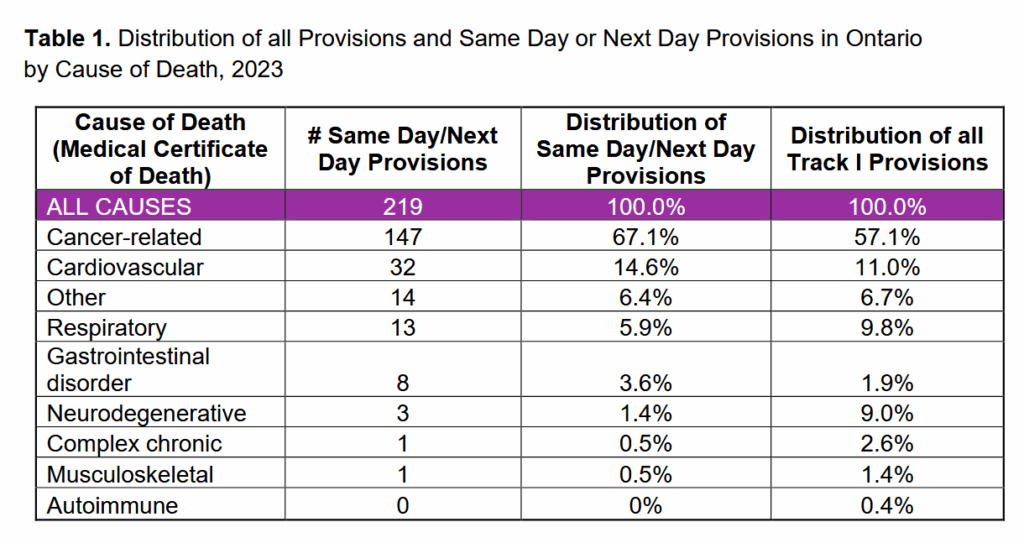
- The table below is taken from MDRC Report 2024-02. It purports to show underlying conditions that were relied upon in the SAD process to justify government-inflicted homicides for which responsibility has been distributed among all members of society. Note that separate lines are provided for “Complex Chronic,” “Musculoskeletal”, and “Autoimmune” causes, to each of which none or single deaths are attributed. It being the case that zero or one killings justified separate listing of those causes, what conditions are covered by the 14 causes grouped under “Other” cases listed on the 4th line? If authors of the report were willing to devote lines to causes with single or no deaths, why could not the 14 “other” causes be defined?
1NOTE: Federal and Provincial authorities identify Socially-Assisted Death practices as “medical assistance in dying, or “MAiD”. Catholic Conscience prefers the acronym “SAD”.
2 MDRC Report 2024-4: Complex Same-Day / Next Day Provisions, accessible at https://macdonaldlaurier.ca/wp-content/uploads/2025/02/MDRC-Report-2024.4_Same-Day-Next-Day-Provisions_Final.pdf. Catholic Conscience thanks the Macdonald – Laurier Institute for making the report available to the public.