
CST Rosary: Third Joyful Mystery - the Annunciation
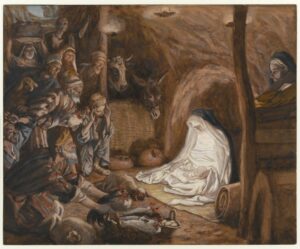
Christ was sent to us to proclaim a New Covenant between humans and God, and thereby establish the Kingdom of Heaven on earth. His Father chose a surprising way of doing that.
The mystery of the Nativity offers rich ground for reflection on the CST principles of life and human dignity, the priority of the family among social institutions, and the preferential option for the poor, as well as the Christian virtue of humility.
Scriptural Reference
Luke 2:1-20(Catholic RSV)1
In those days a decree went out from Caesar Augustus that all the world should be enrolled. This was the first enrollment, when Quirinius was governor of Syria. And all went to be enrolled, each to his own city. And Joseph also went up from Galilee, from the city of Nazareth, to Judea, to the city of David, which is called Bethlehem, because he was of the house and lineage of David, to be enrolled with Mary, his betrothed, who was with child.
And while they were there, the time came for her to be delivered. And she gave birth to her first-born son and wrapped him in swaddling cloths, and laid him in a manger, because there was no place for them in the inn.
And in that region there were shepherds out in the field, keeping watch over their flock by night. And an angel of the Lord appeared to them, and the glory of the Lord shone around them, and they were filled with fear. And the angel said to them, "Be not afraid; for behold, I bring you good news of a great joy which will come to all the people; for to you is born this day in the city of David a Savior, who is Christ the Lord. And this will be a sign for you: you will find a babe wrapped in swaddling cloths and lying in a manger."
And suddenly there was with the angel a multitude of the heavenly host praising God and saying, "Glory to God in the highest, and on earth peace among men with whom he is pleased!" When the angels went away from them into heaven, the shepherds said to one another, "Let us go over to Bethlehem and see this thing that has happened, which the Lord has made known to us."
And they went with haste, and found Mary and Joseph, and the babe lying in a manger. And when they saw it they made known the saying which had been told them concerning this child; and all who heard it wondered at what the shepherds told them.
But Mary kept all these things, pondering them in her heart. And the shepherds returned, glorifying and praising God for all they had heard and seen, as it had been told them.
CST Reflection
We often equate the idea of kingship with power and material plentitude. As humans we are naturally inclined towards these things, and because of our fallen nature it can be easy for us to strive solely towards goods that satisfy the concupiscence of the flesh and eyes, and to revere power and name recognition in an attempt to satisfy our pride. And yet in the mystery of the Nativity, God’s perfect wisdom proves that the poorest, least powerful of the human form is compatible with Divine nature. And He demonstrates this by coming to earth as a tiny baby, born into a stable with no earthly possessions and no name recognition. The Catechism of the Catholic Church cites the following: “Jesus was born in a humble stable, into a poor family. Simple shepherds were the first witnesses to this event. In this poverty heaven's glory was made manifest.”2
The state in which Christ was born is in direct resistance to the threefold concupiscences that all humans are susceptible to, and thus exemplifies the infinite value of the weakest and most lowly of humans. It is in His lowliness that we revere Him. And today, as we meditate upon the mystery of the Nativity, we can think about the lowly and poor among us. As Christ is quoted in Matthew, “Whatever you did for one of the least of these brothers of mine, you did for me.” 3 Christ references the poor among us as He was the poor among us, and in each of our lives, He is the poor among us.
Through this mystery, we are also reminded of the beauty and dignity of the domestic church and the preciousness of the familial unit. This mystery inspires us to remember our responsibility to prioritize the vocation to the family over material goods and power. God chose to be born into the loving arms of Mother Mary rather than onto a throne of grandeur and majesty. He also chose to be born under the protection of St. Joseph, a humble Jewish carpenter rather than under the protection of many legions of men. God, Creator of the universe, could have arranged any kind of entry into the world, yet He chose to take our form in the context of a poor family, and God therefore blesses both the poor and the family. As we pray, we can ask ourselves - do we recognize the image of God in the poor and vulnerable in our lives, and do we honor and love the domestic church that is our own unique family unit?
Fruits of the Mystery
Mother Mary, we pray in the name of your divine Son that by contemplating the circumstances of His birth we might come to a greater appreciation of the inherent dignity of all human life and the critical priority of the family unit, and thus grow toward God together, in a spirit of deep and sincere humility.
______________________
Credits
1 Scriptural Reference: https://quod.lib.umich.edu/cgi/r/rsv/rsv-idx?type=DIV1&byte=4782437
2 Catechism of the Catholic Church, 525, The Mysteries of Jesus’ Infancy and Hidden Life (Pope John Paul II, 1992)
3 Holy Bible, Matthew 25:40 (NIV)
Image: James Tissot, The Adoration of the Shepherds, ca. 1890 (Wikimedia Commons / Brooklyn Museum, public domain)
 In the first installment of a series of Rosary reflections highlighting the