Among bills debated by the House of Commons during the 45th Parliament is C-9, An Act to Amend the Criminal Code (Hate Propaganda, Hate Crime, and Access to Religious or Cultural Places).1 Along with other bills considered during that parliament, it is summarized and annotated on our Parliament Brief page. 2
According to Bill C-9’s sponsor, Justice Minister Sean Fraser, during his introduction at second reading,
…One of the great promises of Canada is the right of its citizens to live freely, regardless of the colour of their skin, the God they pray to, their gender identity or the person they love…
It is important we understand the scale of what we have observed in Canada's recent history. Nearly 5,000 hate crimes are officially reported by law enforcement annually in this country. We know, through conversations with affected communities, that the true number is much, much higher. The under-reporting of hate crimes is in and of itself a symptom of a societal problem: that people may not have faith that the criminal law is actually equipped to deal with the circumstances they face so routinely in their communities.
It troubles me greatly when I open the newspapers and see such stories. When I meet with Jewish Canadians, they tell me that they are beginning to question whether they have a place in this country, as a result of the hate they have been subjected to. I think about what I have witnessed in my own community, with local police laying charges for the advocating of genocide toward Jewish Canadians. Recently in my home province of Nova Scotia, synagogues have been desecrated with hate symbols that seek to intimidate people of the Jewish faith against practising their religion. The National Holocaust Monument has been desecrated. Is there no limit to indecency?
There are many communities that are impacted. I think about Muslim Canadians, who are suffering from a wave of Islamophobia that we must address. I have met with people and visited their mosques, people who have told me what it is like to be harassed in their communities and told me about the fear they have when they seek to gather and pray…
This is completely unacceptable. .. People do not feel safe to practice their religion and to visit their churches, synagogues, mosques, or temples…
I fear that, too often, we, as Canadians, are failing our neighbours. We should seek to be better neighbours. We are responsible, in my view, not only for the acts that we ourselves commit, but for the injustices that we see and accept through our acquiescence and through our inaction. When we see instances of hate in our community, we have a duty to condemn them, to speak up and to show support for our fellow Canadians. It should not be too much to ask that our neighbours take care of one another. Should we adopt that approach, we will collectively be better off. 3
Official Summary:
The Act proposes to amend the Criminal Code to, among other things,
(a) repeal a requirement that the Attorney General consent to the institution of proceedings for hate propaganda offences;
(b) create an offence of wilfully promoting hatred against any identifiable group by displaying certain symbols in a public place;
(c) create a hate crime offence of committing an offence under that Act or any other Act of Parliament that is motivated by hatred based on certain factors;
(d) create an offence of intimidating a person in order to impede them from accessing certain places that are primarily used for religious worship or by an identifiable group for certain purposes; and
(e) create an offence of intentionally obstructing or interfering with a person’s lawful access to such places.
Commentary
Commentary at second reading fell along predictably partisan lines.
- While commending the objectives of protecting vulnerable communities and supporting police and prosecutors, Conservative members questioned:
- Why the bill proposes to define hatred as “the emotion that involves detestation or vilification and that is stronger than disdain or dislike”, rather than adopting the stricter standard adopted by the Supreme Court in Regina v. Keegstra of “extreme detestation and extreme vilification.” The party further questioned why the qualifier “extreme manifestations” had been dropped.
- Why it is proposed to remove the existing requirement that the relevant provincial Attorney General consent to the laying of hate charges.
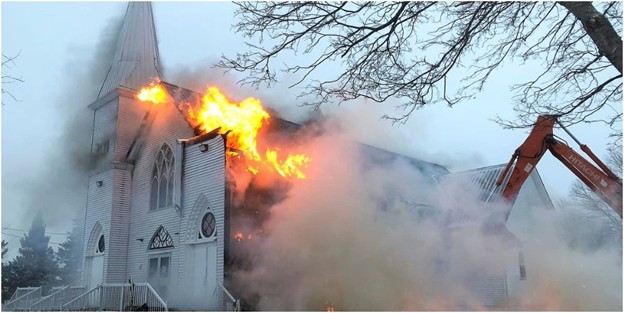
- Why attacks against Christianity within Canada had not been mentioned by the government. When another member laughed at this question, a Conservative member reminded the House that between May 2021 and December 2023 thirty-three Christian churches had been burned in Canada, and that the previous Parliament had declined to condemn the attacks, along with crimes against other religious groups.
- Why it was not proposed to refine existing laws, rather than adding a new and confusing piece of legislation.
- The Bloc Quebecois questioned failure of the propsal to repeal a religious exemption from hate speech, where statements are based on religious texts.
- The Green party questioned why, when several “strong pieces” of hate legislation already exist, additional strictures tied to a new definition of “hatred” are proposed, since “[I]t does not make sense to add new legislation where it is not needed” and thereby make things more confusing.
The Government replied that it welcomed all good-faith criticism, and wished to adapt the bill so that all parties are satisfied. However, several of the objections were stated to be suspected of being based on bad faith.
In the press, Catholic commentators expressed concern over the apparent lack of concern about the federal government toward the more than 300 arsons and acts of vandalism perpetrated against Christian churches since 2021. 4
Points to Ponder
- What is the best way for a society to combat hate? Is it preferable to add laws attempting to carefully circumscribe all combinations and permutations of action and mental states, or to rely on simpler, already existing laws, where they exist and cover the proscribed behaviour?
- Canada Criminal Code Section 434, for example, specifies that “Every person who intentionally or recklessly causes damage by fire or explosion to property that is not wholly owned by that person is guilty of an indictable offence and liable to imprisonment for a term not exceeding fourteen years.” This would cover churches and other places of worship, as well as parked cars, trash bins, and all other forms of property.
- Which is more difficult to prove? That a fire was intentionally or recklessly set, or that it was set with “an emotion of detestation or vilification (extreme or otherwise) that is stronger than disdain or dislike?”
- Would it make sense, in addition or as an alternative to adding new laws, to enforce existing laws? It is charged, for example, that authorities declined to take serious action to investigate or prosecute several of the fires that destroyed Canadian Catholic churches between 2021 and 2023.6
- Do there already exist laws that prohibit individuals from blocking others from access to places of religious worship?
- Do there exist other ways to combat hate, in addition or as an alternative to criminal legislation?
- For example, should public schools teach children that burning churches and other places of worship, or barring worshippers from entering, is wrong?
- Does, could, or should the Catholic Church have any role to play in combatting hate? What, if anything, could or should be done?
- Like arson, murder - and inciting others to commit murder or other forms of violence - is also already illegal in many jurisdictions. Still, it is reported that following the murder of activist Charlie Kirk in September 2025, a number of public figures openly praised the killing6 in terms that might well be construed as approving of the killing of individuals who speak publicly against their own ideas. Such figures included, for example:
- A professor of political science and religion at the University of Toronto, who shared a post citing the killing as “honestly too good for so many of you fascist c—ts.”
- A University of Calgary associate professor, who posted comments including “Bullseye” and “Charlie Kirk no longer exists” together with an emoji of a laughing face.
- The province of Manitoba’s Minister of Families, who shared a post stating that “I extend absolutely no empathy for people like that.”
Do such statements fall as “hate speech,” or as motivated by hatred, within the strictures of the proposed law, or any other? To the extent that they incite further violence, should such statements be curtailed?
- As noted above, concerns have been stated about the apparent governmental indifference to crimes against Christian communities. In introducing and justifying the bill, however, Minister Fraser stated, among other things, that “People do not feel safe to practice their religion and to visit their churches, synagogues, mosques, or temples…”3
- The term "place of religious worship" does not appear to be defined within t bill. However, most dictionaries accept that a “church” is a place of Christian worship, or a body of Christian believers.
- Is it important that Catholics and other Christians respect truth and fairness in argument?
- If so, is the fact that the Minister led his list of worship houses with churches relevant?
- It seems undeniable that the previous government was not very interested in defending Catholics or other Christians from persecution. Has the current government given any indication of its interest level?
Sources:
- https://www.parl.ca/legisinfo/en/bill/45-1/c-9
- https://catholicconscience.org/canada-federal-45th-parliament/
- https://www.ourcommons.ca/DocumentViewer/en/45-1/house/sitting-28/hansard#13139629
- https://www.catholicregister.org/item/2799-christianity-absent-in-proposed-hate-legislation
- https://catholicinsight.com/2025/03/20/as-churches-continue-to-burn-its-time-catholics-mobilized/
- https://files.constantcontact.com/1c6e676d401/2de146ed-824a-467b-a72c-48050ec5bb1e.pdf?rdr=true; https://nationalpost.com/news/canada/charlie-kirk-nahanni-fontaine-wab-kinew