
Paradigm of Tolerance and Charitable Love: Venerable Pierre Toussaint
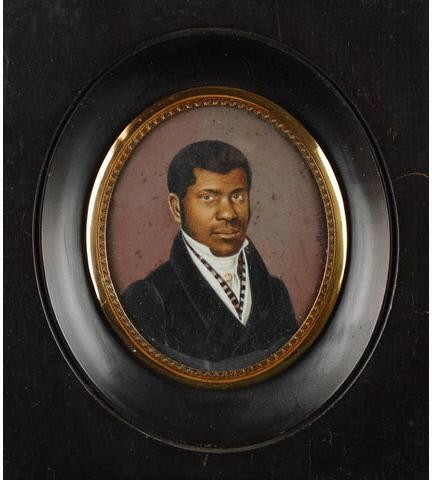
Venerable Pierre Toussaint (1766-1853)
Image: A 1825 paining of Pierre Toussaint by Anthony Meucci, Public domain, via Wikimedia Commons
When he saw the crowds, Jesus went up the mountain, and after he had sat down, his disciples came to him. He began to teach them, saying… You have heard that it was said, ‘An eye for an eye and a tooth for a tooth.’ But I say to you, offer no resistance to one who is evil. When someone strikes you on your right cheek, turn the other one to him as well. If anyone wants to go to law with you over your tunic, hand him your cloak as well. Should anyone press you into service for one mile, go with him for two miles. Give to the one who asks of you, and do not turn your back on one who wants to borrow. (Matthew 5:38-42).
Few people have lived these words like Venerable Pierre Toussaint. Born into slavery on a Haitian sugar plantation and taken to New York in slavery as an adult, he not only cheerfully served those who subjugated and claimed to own him, but contrived by cheerful, faithful service to earn enough money to buy others out of slavery and ultimately, upon earning his own release, to purchase a home that he shared with the poor, orphans, the sick, and others in need.
Teaming in other good works with his wife, who was among those for whom he purchased an acknowledgement of freedom, he ultimately came to be acknowledged as the de facto founder of Catholic Charities of the Archdiocese of New York.
Truly Venerable Pierre Toussaint offers a lesson from which many people might benefit.
Points to Ponder:
The Theological Virtues of faith, hope, and charity are explained in Sections 1812 to 1829 of the Catechism of the Catholic Church. Section 1822 teaches that “charity is the virtue by which we love God above all things for his own sake, and our neighbor as ourselves for the love of God.” (Compare Matthew 22:34-40)
Section 1825 teaches that the Apostle Paul has given the incomparable description of charity:
Charity is patient and kind, charity is not jealous or boastful; it is not arrogant or rude. Charity does not insist on its own way; it is not irritable or resentful; it does not rejoice at wrong, but rejoices in the right. Charity bears all things, believes all things, hopes all things, endures all things.
(Quoting 1 Corinthians 13)
How well did Venerable Pierre Toussaint’s behaviour meet Saint Paul’s description?
- Did he demonstrate patience and kindness? It is reported that:
- during his enslavement he accepted education from his enslavers, served them lovingly, and while still enslaved worked his way as an adult through apprenticeship to become a successful hairdresser for prominent New York women – including the wife of Treasury Secretary Alexander Hamilton – at a time when such women tended to use their maids for hairdressing; and that attracted a large a large clientele by his intelligence, artistry, and civility.
- when the couple who claimed ownership of him lost their money and property and the husband died, Pierre willingly took on the role of supporting his former master’s wife, her new husband, her extended family, and his own still-enslaved relatives, financially and otherwise.
- even after he was freed at the age of about 40, he corresponded with the family that had claimed to own him.
- following his release, he bought his sister’s freedom, along with the woman he married. After his sister died, he adopted her daughter.
- together with his wife, became involved in a number of charitable efforts,
- beginning by taking baked good to children at the Colored Orphan Asylum and donating money;
- sheltering orphans, sick people (including at least one priest) and others in need in his own home, and supporting them in education and vocational training;
- organizing a credit bureau, an employment agency, a refuge for priests and needy travelers;
- helping immigrants, particularly by using his ability in the French language to help Haitian refugees;
- helping open the first Catholic school in New York for Black children, at St Vincent de Paul on Canal street.
- In doing these things, it is reported that he worked assiduously to control his own fiery temper.
- Did Venerable Pierre show jealousy, or boast? Is he reported to have been arrogant or rude? Does he appear to have insisted on having his own way? Was he irritable or resentful? It is reported that:
- he acknowledged that he consciously fought his own naturally quick temper and supressed a talent for mimicry, explaining that he realized that anger and mimicry from him might not be well tolerated by the society that claimed power over him.
- from the time he was allowed to go free in 1807, until New York abolished slavery twenty-two years later, he risked abduction and re-enslavement by bounty hunters simply by going outdoors, walking everywhere because Blacks were not allowed to use public transportation.
- he helped raise funds for the first Catholic orphanage in NY, which was opened by the Sisters in Charity, even though it served only white children.
- Did Venerable Pierre rejoice at wrong, or at right? It is reported that:
- upon being released from legal bondage he took the surname Toussaint in honour of the Catholic Haitian revolutionary, Toussaint L’Overture, who led his country to freedom while remaining faithful to his beliefs.
- he attended Mass daily for 66 years, and contributed liberally to the construction of the new Saint Patrick’s.
- at the time of the proclamation of venerability in 1997, some people are reported to have disagreed with the declaration, on grounds that although he had been born into slavery, he did not resist his enslavement, or work to end slavery as an institution.
At his death, Venerable Pierre was buried in the cemetery of Old Saint Patrick’s Church in New York City. In the 1950s, the Irish-American John Boyle O’Reilly Committee for Interracial Justice began a campaign to research and publicize Venerable Pierre’s life story. In 1968, Cardinal John O’Connor, Archbishop of New York, named him a Servant of God and transferred his body to the crypt of Saint Patrick’s Cathedral; he remains the only lay person interred there. In 1997, he was declared venerable by Pope Saint John Paul II.
As Saint Paul put it, “charity bears all things, believes all things, hopes all things, endures all things.” (1 Corinthians 13:7)
Sources:
- Catechism of the Catholic Church, 1826.
- https://slaveryandremembrance.org/people/person/?id=PP051
- https://www.nytimes.com/2024/02/18/obituaries/pierre-toussaint-overlooked.html
- Franciscan Media: https://www.franciscanmedia.org/saint-of-the-day/venerable-pierre-toussaint/
- https://en.wikipedia.org/wiki/Pierre_Toussaint