Annual Conference, Subsidiarity, and the Rosary
In this issue, we thank the many, many people who have helped us, now and over the years. Our volunteers – including our remarkable board of directors – our program coordinators, and most especially our readers and donors. You not only make this project worthwhile, you make it fun – and possible. God bless you all.
We were asked recently to identify one or two people who have benefitted from the work we do at Catholic Conscience. It set us a back a bit, because in general we don’t know the people who benefit from our work – they are voters and students from across North America, who we “see” everyday in our site monitor, joining classroom discussions of the principles and values of Catholic Social Teaching, consulting our voter guides, learning about the concept of social sin.
But we do see people who benefit, face to face too. Politicians and staffers who come to us with ideas and for suggestions, young Catholics looking for ways to help make a difference, writers who want to raise their profiles.
More importantly, we benefit ourselves from coming to know you and hearing about ways in which we can help.
We’re hosting our first annual conference this year, in May. Details and a link to the conference website are provided below. Please come meet us. We would love to know you, too.
Conscience Conversation
Empowerment, Catholic Style
Thanks to its name, “subsidiarity” is probably the least understood of Catholic social principles. It is not actually difficult to understand, however, and when properly understood can be readily accepted as one of the most important of Catholic social concepts. One key to understanding may lie in thinking of it as “empowerment, Catholic style.”
To help clarify the implications of this important principle, we reached out to Catholics across the country, including several of the nation’s leading voices in social justice, and have incorporated respondents’ comments into the discussion below.
In simple terms, the principle of subsidiarity states that each element of society should serve its own proper purpose, and support others in serving theirs, with the over-arching goal of encouraging and enabling authentic human development for the whole of society. All social elements are called to support one another by providing any required help, or “subsidium.” This includes staying out of the way of other, properly responsible social elements. One consequence of this principle is that each individual, and all smaller groups of people, should be allowed to make for themselves all the decisions that can responsibly be left to them, and to look after their own affairs with the help of other and greater authorities, if and as required.
Jennifer Ide, St Patrick’s Church, Toronto:
As someone new to the concept of subsidiarity, I found this reflection both enlightening and encouraging. I was reminded of 1 Corinthians 12:14-27, where the Body of Christ is made up of many distinct parts, each contributing something valuable in its own way. Even the parts that seem smaller have a purpose that cannot simply be assumed by another - the heart could never fulfill the role of the ear, nor the ear that of the heart - and the health of the whole depends on each part carrying out its own role while supporting, rather than overtaking, the work of the others.
The Church considers it wrong for any “higher” or stronger authority to arrogate to itself responsibilities or privileges that could responsibly be left to “lower” or weaker groups. Thus for example federal governments should help state and provincial governments do things, rather than doing them themselves, just as provincial governments should leave responsibilities to individuals, families and local communities wherever possible.
Father Kevin Belgrave, St Augustine’s Seminary Toronto:
I’ve always thought of subsidiarity in the following terms: there is a “scale” to the image of God… the scale of the family, of the neighborhood, of the city, etc, etc. Each level of the scale is essential to the human person’s capacity to thrive. If one rung in the scale is weak, there will be something missing for the person’s full thriving. Each “rung” or element of the scale needs to respect the work of the other parts. I don’t usually think of it as “higher” or “lower” just different. Family needs to respect the goods that only come through the “city” (etc) and the rungs of political community need to respect the goods that only come through family and neighborhood (i.e., mediating institutions).
Miles Smit, PhD, Petrarch Institute
The Faith is both Incarnational and Hierarchical. Because it is Incarnational, it must uphold all the local dignities that go with a Body -- thus Subsidiarity defends every competency that particular bodies from the individual to the family to the broader community can exercise. Because it is Hierarchical, the Faith seeks to align, embed and integrate every local authority in the higher levels.
As explained by the Compendium of the Social Doctrine of the Church, this view of empowerment “is imperative because every person, family and intermediate group has something original to offer to the community. Experience shows that the denial of subsidiarity, or its limitation in the name of an alleged democratization or equality of all members of society, limits and sometimes even destroys the spirit of freedom and initiative.” (Compendium, 187)
Kathleen Muggeridge, Young Professional Catholics of Toronto:
Subsidiarity is therefore a critical factor in the empowerment of the common good. A great fruit of this teaching exists on the spiritual plain; subsidiarity provides room for the individual to freely submit to God and His unique and perfect Will for their life, thus leading to the flourishing of the individual's personal relationship with Him. The opposite happens when subsidiarity doesn't exist and the individual will of a person is absorbed by governing authorities; the individual's ability to give a true "fiat" to God's call from the depths of their heart is inhibited if not fully uprooted.
Professor Danielle Morin, Montreal:
God entrusts real responsibility to individuals and communities. Each person and group has something unique to offer and should not be replaced by larger structures. True empowerment is not doing whatever we want, but growing in freedom rooted in truth and the common good. Lived well, subsidiarity protects dignity, encourages initiative, and leads us closer to God.
Being a Catholic doctrine and therefore oriented toward the authentic development of the individual, this brand of empowerment comes with some conditions. For example, while it promotes the idea of empowering individuals and smaller groups to express their freedom, it is meant to promote authentic freedom, which is intimately bound to truth and the needs of the common good, and therefor points directly toward God.
This distinguishes Catholic subsidiarity from some secular conceptions of empowerment, which encourage individuals to seek the realization of their own “inner truths” by indulging whatever impulses or desires they see fit, with no firm reference to their own authentic needs, or the needs or interests of others - even to the point of chasing unreal fantasies or indulging greedy inclinations.
In summary:
Peter Copeland, Toronto
I think it might help to expand on why the church promotes subsidiarity. Although it might come off sounding a bit theoretical, it all works very nicely when you couch explanations of CST principles in logical terms, starting a logical chain with our creation in the image of God, Imago dei, and the imperative of serving the common good, and working onward from there. For example, we are made Imago dei, and to live that reality we are given freedom and meant to use it in society; and we do so by developing and exercising our capacities, which includes responsibility and ownership of the things in our lives. That's why we have subsidiarity - it helps us develop and exercise our freedom properly, which is done by seeking truth and promoting goodness in the social form, which is the common good. Teleologically, subsidiarity is present when those who ought to be responsible for a given order are using it for the realization of the common good.
George Cervinka, Montreal
Subsidiarity becomes clearest in practice when we notice what goes wrong without it: well-meaning systems that centralise decisions end up weakening families, parishes, and local institutions rather than strengthening them. Catholic empowerment is not about maximising choice, but about placing responsibility where it can be carried truthfully, with higher authorities supporting rather than substituting.
Events
Annual Conference - May 30, 2026
Catholic Conscience’s first annual conference on Building a Culture of Life and Dignity will be held on Saturday, May 30, 2026 at De La Salle Oaklands College, 131 Farnham Avenue, in Toronto, Ontario.
The topic of our first year’s conference will be Restoring the Covenant: CST as Common Social Ground. As a part of the larger series, the conference is intended to advance at least three separate but related purposes:
1st - to advance civic conversation on the restoration of a social covenant based on shared principles and values.
2nd - to bring together all Canadian Catholic social and civic initiatives (along with others of goodwill), to increase awareness and promote cooperation among them.
3rd - to promote engagement between volunteers and those seeking full- and part-time employment, and to promote fundraising possibilities, for such civic initiatives.
The conference should be of interest to all Catholics and others of goodwill who seek to improve society by re-establishing common social principles and values, as an alternative to radical individualism and other social currents that tend to draw people apart from God and one another. We anticipate a number of relevant presentations and discussions, including the participation of many leading Canadian Catholic voices. Side meetings and small group conversations will also be encouraged throughout the day.
Further information can be found at https://culturelifedignity.org/. The website will be updated as details become available.
![]()
Prayer
A Prayer to the Creator
The CST Rosary
With this issue, we launch a new series of Rosary reflections, illustrating the principles, values, and virtues of Catholic Social Teaching through the Joyful, Luminous, Sorrowful, and Glorious Mysteries.
The first Mystery highlights the meaning of subsidiarity, particularly as applied in a context of humility and a profound spirit of stewardship.
______
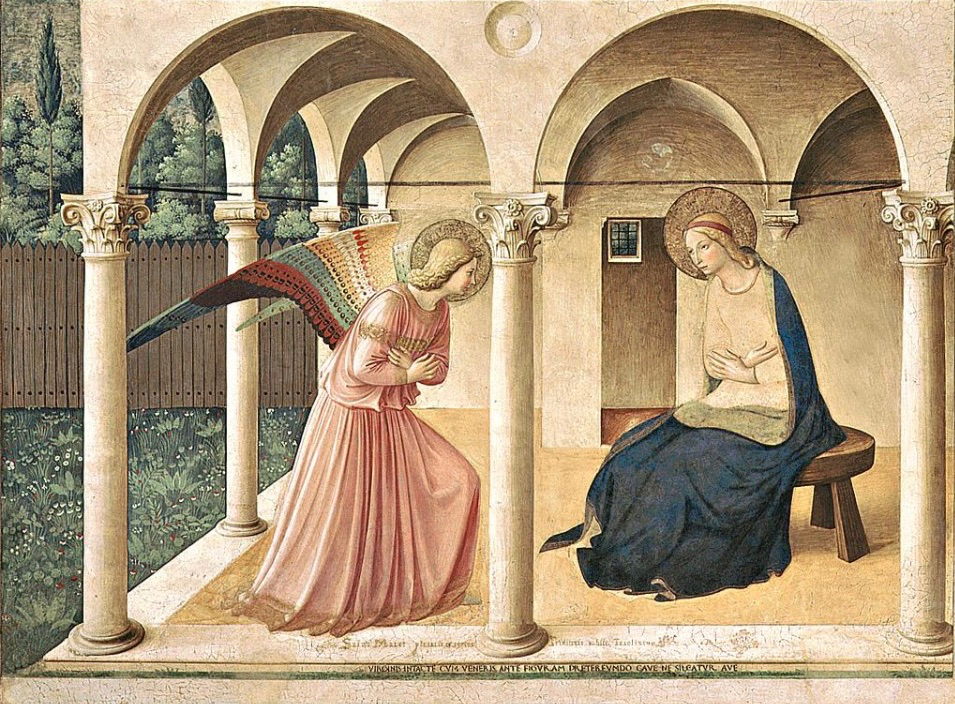
First Joyful Mystery: The Annunciation
______
Scriptural Reference
Luke 1:26-38 (Catholic RSV*):
In the sixth month the angel Gabriel was sent from God to a city of Galilee named Nazareth, to a virgin betrothed to a man whose name was Joseph, of the house of David; and the virgin's name was Mary. And he came to her and said, "Hail, O favored one, the Lord is with you!"
But she was greatly troubled at the saying, and considered in her mind what sort of greeting this might be. And the angel said to her, "Do not be afraid, Mary, for you have found favor with God. And behold, you will conceive in your womb and bear a son, and you shall call his name Jesus. He will be great, and will be called the Son of the Most High; and the Lord God will give to him the throne of his father David, and he will reign over the house of Jacob for ever; and of his kingdom there will be no end."
And Mary said to the angel, "How shall this be, since I have no husband?" And the angel said to her, "The Holy Spirit will come upon you, and the power of the Most High will overshadow you; therefore the child to be born will be called holy, the Son of God. And behold, your kinswoman Elizabeth in her old age has also conceived a son; and this is the sixth month with her who was called barren. For with God nothing will be impossible."
And Mary said, "Behold, I am the handmaid of the Lord; let it be to me according to your word." And the angel departed from her.
_________
CST Reflection
The Rosary opens with a striking example of one of the most important and least understood of all Catholic social concepts: subsidiarity.
The confusion surrounding this principle appears to arise from its name. It is not actually difficult to understand, however, particularly when illustrated by example or when thought of as a Catholic form of “empowerment.”
In simple terms, the principle of subsidiarity states that each element of society should serve its own proper purpose, and support others in serving theirs, with the over-arching goal of encouraging and enabling authentic human development for the whole of society. All social elements are called to support one another by providing any required help, or “subsidium.” This includes staying out of the way of other, properly responsible social elements. One consequence of the principle is that each individual, and all smaller groups of people, should be allowed to make for themselves all the decisions that can responsibly be left to them, while rightfully being able to look to higher authorities for help, if and when help is required.
Has there ever existed a better example of this principle than the Annunciation? Consider the act of God the Almighty Father, Eternal King and Creator of the Universe, in approaching a young girl in a small village otherwise barely known to history, to ask her assistance in bringing His only Son, whom He has designated to be the savior of the world, to life in human form. Rather than doing the job the easy way, sending Christ down fully formed on a cloud with a backdrop of lightning, God elected to glorify His own creation by appointing a devout, patient, and capable young woman from a tiny and obscure village to the task, and letting her do it.
Importantly, God did not just give her the job and then abandon her. He sent her support in the form of a strong, humble, understanding husband, Joseph, to watch over her as she gave birth alone in a stable, and to accompany her into exile in a foreign land to avoid her child's slaughter. Neither did God specify each and every detail of His Son’s upbringing and activity as the child Jesus grew and began his earthly ministry. He continued to watch over the family all the way along, through all of Christ’s life and mission, while Mary and Joseph put their own unique parental stamp on His Son, helping to shape the child’s experiences and responses to them, and while Jesus practiced his mission through teaching at synagogues and the Temple.
By choosing this path, God allowed both Mary and Joseph to apply and develop their talents over their entire lifetimes. In doing so, they not only shaped Christ’s life and humanity; they also provided all the rest of us with shining examples of the virtues of charity, obedience, and humility, as well as realistic self-assessment, respect, hard work, and good stewardship: qualities that Mary and her husband have continued to put to good use on our behalf through the entire subsequent 2000 years.
As explained by the Compendium of the Social Doctrine of the Church, the Catholic principle of subsidiarity “is imperative because every person, family and intermediate group has something original to offer to the community. Experience shows that the denial of subsidiarity, or its limitation in the name of an alleged democratization or equality of all members of society, limits and sometimes even destroys the spirit of freedom and initiative.” (Compendium, 187)
_________
Fruits of the Mystery: Mother of God, we pray in the name of your divine Son that by contemplating your faithful answer to God’s call we might grow in faithful and selfless attention to our own duties, recognizing the help God sends us in our own missions and following faithfully the example you provided of impeccable stewardship of the gift of life.
_________
Credits
* Scriptural Reference: https://quod.lib.umich.edu/cgi/r/rsv/rsv-idx?type=DIV1&byte=4782437
* Image: Fra Angelico, the Annunciation. San Marco, north Corridor (Wikimedia Commons)

Donate
We promise to put your gift to work.
Every election cycle we grow.
Your gift will help us keep up.
Catholic Conscience is a registered Canadian charity, Registration no. 701256521RR0001.
To make things easy, we work with CanadaHelps. You will receive a tax receipt immediately and with our thanks.