 Church Teaching
God gave humans dominion over the earth, thereby making us stewards of creation as we work with Him in His continuing act of creation.
We must constantly consider how our actions glorify or harm this wonderous gift God has entrusted to us. This is a multi-faceted question, which must not be over-simplified.
With a vocation to glorify all life which includes respect for the inviolability and integrity of life, humans find themselves in the presence of all God’s other creatures. We can and are obliged to put them at our own service and to enjoy them, but our dominion over the world requires the exercise of responsibility. It is not a freedom of arbitrary and selfish exploitation. All of creation has value and is “good” in the sight of God. This is a marvelous challenge to human intellect. – 112, 113, Compendium of the Social Doctrine of the Church.
Living our vocation to be protectors of God’s handiwork
is essential to a life of virtue; it is not an optional or
secondary aspect of our Christian experience.
-217, Laudato Si’
The Book of Genesis provides us with certain foundations of Christian anthropology, including the meaning of human activity in the world, which is linked to the discovery and respect of the laws of nature that God has inscribed in the created universe, so that humanity may live in it and care for it in accordance with God’s will. – 37, Compendium of the Social Doctrine of the Church.
When nature is viewed solely as a source of profit and gain, this has serious consequences for society. This vision of “might is right” has engendered immense inequality, injustice and acts of violence against the majority of humanity, since resources end up in the hands of the first comer or the most powerful: the winner takes all. Completely at odds with this model are the ideals of harmony, justice, fraternity and peace as proposed by Jesus. As he said of the powers of his own age: ‘You know that the rulers of the Gentiles lord it over them, and their great men exercise authority over them. It shall not be so among you; but whoever would be great among you must be your servant” (Mt 20:25-26). -82, Laudato si’.
Climate Change
There is urgency to this issue. Every Pope since at least Paul VI has written of our need to shift to a more responsible use of the earth and its abundant resources. The Church accepts that that need is now urgent.
“A very solid scientific consensus indicates that we are presently witnessing a disturbing warming of the climatic system… Humanity is called to recognize the need for changes of lifestyle, production and consumption, in order to combat… at least the human causes which produce or aggravate it. It is true that there are other factors, yet a number of scientific studies indicate that most global warming in recent decades is due to the great concentration of greenhouse gases released mainly as a result of human activity. – Pope Francis, Laudato si’, –23
Energy & Resources
The good steward neither allows the resources entrusted to him to lie fallow or to fail to produce their proper fruit, nor does he waste or destroy them (Matthew 25:14-30). Rather, he uses them responsibly, for the Lord’s purposes, to realize their increase so that he may enjoy his livelihood and provide for the good of his family, his descendants, and his neighbors.
Humanity’s relationship with creation and the creatures of the earth “requires the exercise of responsibility, it is not a freedom of arbitrary and selfish exploitation.” – 115, Compendium of the Social Doctrine of the Church
One of the higher priority issues in economics is the utilization of resources, that is, of all those goods and services to which economic subjects — producers and consumers in the private and public spheres — attribute value because of their inherent usefulness in the areas of production and consumption… Resources in nature are quantitatively scarce, which means that each individual economic subject, as well as each individual society, must necessarily come up with a plan for their utilization in the most rational way possible, following the logic dictated by the “principle of economizing.” – 346, Compendium of the Social Doctrine of the Church
Because of the powerful means of transformation offered by technological civilization, it seems that the balance between man and the environment has reached a critical point… A reductionistic conception quickly spread, starting from the presupposition — which was seen to be erroneous — that an infinite quantity of energy and resources are available, that it is possible to renew them quickly, and that the negative effects of the exploitation of the natural order can be easily absorbed… – 461, 462, Compendium of the Social Doctrine of the Church
Conservation & Sustainable Development
Care for the environment represents a challenge for all of humanity. It is a matter of a common and universal duty, that of respecting a common good, destined for all, by preventing anyone from using “with impunity the different categories of beings, whether living or inanimate — animals, plants, the natural elements — simply as one wishes, according to one’s own economic needs.”
Responsibility for the environment, the common heritage of mankind, extends not only to present needs but also to those of the future… This is a responsibility that present generations have towards those of the future… A correct understanding of the environment… at the same time…must not absolutize nature and place it above the dignity of the human person himself. In this latter case, one can go so far as to divinize nature or the earth, as can readily be seen in certain ecological movements that seek to gain an internationally guaranteed institutional status for their beliefs. – 346, 461-463, Compendium of the Social Doctrine of the Church
Species Diversity & Wildlife
Man and woman find themselves also in the presence of all the other creatures. They can and are obliged to put them at their own service and to enjoy them, but their dominion over the world requires the exercise of responsibility, it is not a freedom of arbitrary and selfish exploitation. All of creation has value and is “good” in the sight of God, who is its author. Man must discover and respect its value. This is a marvellous challenge to his intellect, which should lift him up as on wings towards the contemplation of the truth of all God’s creatures, that is, the contemplation of what God sees as good in them. Man must recognize all of God’s creatures for what they are and establish with each of them a relationship of responsibility. – 113, Compendium of the Social Doctrine of the Church
“Each of the various creatures, willed in its own being, reflects in its own way a ray of God’s infinite wisdom and goodness. Man must respect the particular goodness of every creature, to avoid any disordered use of things which would be in contempt of the Creator and would bring disastrous consequences for human beings and their environment.” – 339, Catechism of the Catholic Church
It is a responsibility that must mature on the basis of the global dimension of the present ecological crisis… This perspective takes on a particular importance when one considers, in the context of the close relationships that bind the various parts of the ecosystem, the environmental value of biodiversity, which must be handled with a sense of responsibility and adequately protected… – 466, Compendium of the Social Doctrine of the Church
—
The ultimate destiny of the universe is in the fullness of God, which has already been attained by the risen Christ, the measure of the maturity of all things. Here we can add yet another argument for rejecting every tyrannical and irresponsible domination of human beings over other creatures. The ultimate purpose of other creatures is not to be found in us. Rather, all creatures are moving forward with us and through us towards a common point of arrival, which is God, in that transcendent fullness where the risen Christ embraces and illumines all things. Human beings, endowed with intelligence and love, and drawn by the fullness of Christ, are called to lead all creatures back to their Creator. -83, Laudato si’
 Centre BC
Energy & Resources
Alberta-BC Oil Pipeline
In an online policy statement dated October, 2026, the party advocates fast-tracking the proposed Alberta-BC oil pipeline and committing to an additional $60 million investment in skilled trades training to support job creation and expand opportunities for British Columbians.
Sustainable Development
In a policy statement published online 16 February 2026, the party advocates building a balanced and sustainable economy, championing existing industries and businesses, small and large, while fostering innovation to secure good jobs, along with modernizing the provincial education system to prepare youth for the future.
The party has published no current statement concerning its polices regarding:
-climate change
-species, diversity, or wildlife
 Christian Heritage Party of BC
Climate Change
The party states that:
– climate is subject to change due to many factors, including natural causes
– it does not believe that CO2 is the primary cause of climate change nor does it subscribe to climate alarmism with frantic and expensive efforts to eliminate the use of carbon-based fuels
– it advocates responsible and cost-effective research into potential alternative energy sources while allowing the ongoing use, development and transportation of reliable and time-tested energy sources such as— but not limited to—oil, wood, natural gas and coal
– it is concerned about the release of man-made chemical emissions into BC’s beautiful blue skies under Weather Modification efforts. A Christian Heritage Party of BC Government will defend the right of BC residents to have no chemical additives deliberately released into BC skies by any government agency or private corporation. It will renew environmental monitoring and protection of BC’s air and skies from unwanted deliberate emissions.
Energy & Resources; Sustainable Development
The party advocates:
– expanding hydroelectric power, especially environmentally-friendly run-of-river projects, opening up the mining industry and rejuvenating the forest industry by reducing bureaucratic red tape and moving to a market based system that is open to all operators including small businesses
– encouraging the use of methanol in gasoline sold within the province
– encouraging construction of plants to convert wood fibre and other products to clean petroleum
– encouraging the Forest Industry to harvest pine beetle infested trees and reseed the harvested area as soon as possible. This will salvage the trees that would otherwise go to waste and will create jobs in the Forest Industry. Timber that cannot be used for lumber or pulp will be turned into liquid bio-fuel
– active promotion of the creation of energy via alternate methods, including wind power, tidal power, solar power and hydrogen power, including the production of hydrogen and bio-fuel from bio-waste such as effluents, junk fish, dead trees and agricultural waste materials
– actively encouraging the building of a bridge from the Mainland to Vancouver Island that incorporates tidal power generators into the structure and generates enough tidal power to pay the capital construction cost and maintenance cost of the bridge over a reasonable time
– amending the Mineral Tenure Act to prohibit unauthorized access to private property for mineral exploration
– reducing the regulation and red tape that prevents more resource-based industries from opening in British Columbia
– promoting the long term generation of electricity by using;
1 – existing hydro electric generating facilities
2 – in-stream turbines
3 – wind generators where practical and deemed to be safe
4 – bio-generation methods to make use of our wastes and effluents
5 – off shore wave generation (using the likes of Pelamis machines)
6 – direct hydrogen generation (using standing, contained effluents)
7 – solar energy
8 – thermal energy
9 – nuclear energy but not until viable waste-disposal solutions have been found; promoting research into the promising Thorium Reactor which appears to be cleaner, safer and to have a more readily-available supply of mineral fuel
10 – geothermal power generation and heat exchange technology; and in addition, any new technology that is developed will be investigated and assessed
In the interim, the party advocates:
1- expanding and improving mass transit facilities where economically feasible
2- facilitating commercial traffic flow and possibly rewarding its use during off-peak hours
3- providing tax credits for research in clean burning fuels for commercial transportation
4- encouraging the use of electric / hydrogen powered vehicles
5- encouraging hydrogen containment and generation technology development in BC
6 – embarking on a major education program aimed at conserving energy
 Conservative Party of BC
Species, Diversity & Wildlife
The party’s 2025 Policy Declaration advocates:
-in order to provide the guaranteed access to public lands and wild areas that BC residents deserve, including hunting and fishing rights, ensuring transparency and inclusivity by ensuring that Indigenous peoples and other stakeholders, including hunters, fishers, environmentalists, and conservationists, are actively involved in planning and shaping wildlife management practices; and that science-based decisions are supported, in preference to ideological meddling.
-dedicating revenue from tags and fees to wildlife management and enhancement, especially by third parties
-clearly designating areas of forsts that will be protected in perpetuity in order to protect biodiversity
-involving hunters in relevant data collection activities
-increased funding for conservation officers, in order to expand enforcement and protection for wildlife
-ensuring that wildlife protection measures are formulated in BC, not Ottawa
-promoting health among seniors and youth through hunting and fishing
Energy & Resources; Sustainable Development
The party’s 2025 Policy Declaration acknowledges the government’s responsibility to facilitate proper stewardship of both renewable and non-renewable resources, and advocates:
-balancing responsible environmental and tax policies to encourage those activities best able to thrive and prosper in the diverse regions of the province.
Global Energy Superpower
In an online policy statement dated 5 October 2026, the party states that British Columbians, like people around the world, are feeling the effects of global crises, from the war in Ukraine to the blockage of the Strait of Hormuz to shifting American priorities and hostility from the Trump administration. The world is demanding reliable suppliers of the most important inputs, and that is BC’s opportunity to become an energy superpower. BC has the resources, workers and strategic location to become a global energy leader. To that end, the party advocates doubling natural gas production by 2032 and tripling it by 2035, creating good-paying jobs, attracting billions in investment and generating new revenue for the services British Columbians rely on. This includes:
-working with industry to assess barriers to investment from the CleanBC plan and ending unnecessary regulatory burdens that have created complexity and driven away investment.
-completing updated life cycle analyses showing the benefit of BC LNG displacing more GHG intensive forms of energy in overseas markets including Asia and gas from hostile powers like Russia in Europe.
Reducing restrictions
-ending emissions limits that are currently stopping further investment in BC beyond LNG and driving projects to hostile countries and countries with worse environmental and social records.
-replacing the costly and confusing carbon tax framework, which is holding back new LNG development, with stable guidance that rewards operators without penalizing BC exports against US and Qatari competitors.
-harmonizing project permitting, approvals and consultation to align with Bill C-39 to ensure BC led projects are approved within the new federal one year time frame. This will be directly supported by a 120 Day Approval Process in legislation.
-making B.C. natural gas the most competitive to produce, with legal permit deadlines and long-term development plans built in partnership with Treaty 8 nations.
-designating the Montney Formation’s gas reserves a strategic provincial asset.
-establishing resource development corridors that enable in linear infrastructure, including new and existing pipeline expansions required to grow the sector, reducing impacts and improving coordination with Indigenous groups before projects begin.
-backing the pipeline expansions already in motion: Coastal GasLink’s second phase, Prince Rupter Gas Transmission, and Enbridge’s Sunrise expansion on the West coast system.
Increasing power
-allowing significant increase in the domestic power needed for LNG development in BC, including driving growth within the renewable energy sector.
-getting the North Coast transmission line built on a fixed deadline, holding regular calls for new poewr so LNG never competes with homes and businesses for electricity, and giving plants carbon-price certainty that rewards the cleanest operators without charging BC exporters costs their competitors don’t pay.
-including renewables, hydro- and gas-fired plants in the regular calls for power.
Jobs
-working with industry, First Nations, and BC universities and colleges to develop a clear plan for building up the labour market for new projects.
-bringing an LNG focus on skills-to-employment strategy with particular focus on future good-paying jobs in natural gas, LNG, and NGL operations for BC grads.
-encouraging corporate proponents of LNG to return their headquarters back to BC, including inviting ExxonMobil, Chevron, Petronas, and Woodside to come back.
-working urgently with First Nations, mayors, councils, and proponents to insure that hospitals, schools and other services are available in relevant locations.
Climate Resilience: wildfires and habitat protection
The party’s 2025 Policy Declaration advocates:
-effective landscape management, including re-introduction of controlled burns for fire protection and containment; maximizing use of wetter spaces to keep wildfires on the ground and prevent spreading; focusing harvesting on areas damaged by wildfires or forest health issues.
-protecting wildlife habitat by ending aerial spraying of glyphosate.
-working with universities, communities, and volunteers to maximize effectiveness of fire prevention and fire fighting techniques.
In an online policy statement dated 2 October 2026, the party pledged that it would advocate implementation of the Wildfire Action Plan to protect BC’s communities, including buying water bombers, clearing dangerous fuels, speeding up safe prescribed burns, helping crews work together faster, and funding early detection technology.
-the party notes that British Columbia has been devastated by wildfires over the past decade, and that behind those fires are families who packed up what they could and left, not knowing whether they would have a home to come back to.
-the party states that controlled burns are one of the most effective tools for reducing wildfire risk. But lengthy approvals are needed even for routine, predictable burns. And when fire strikes, nearby firefighting crews face red tape of their own, even when they’re just down the road.
The party advocates:}
•procuring new firefighting aircraft, including waterbombers
•reducing dangerous forest fuels around communities;
•making prescribed fire easier to use without lowering safety standards;
•allowing qualified firefighting resources to work more quickly during emergencies;
•creating a dedicated fund to invest in early detection and prevention technologies.
Forestry
The party’s 2025 Policy Declaration states that since the softwood lumber dispute began, the US has collected $9 billion in duties from Canadian producers, much of it in BC. The funds are being held in deposit while the dispute continues. The party advocates:
-not standing idly by while forestry jobs are jeopardized. It proposes pushing the federal government to provide loans against the $9 billion held by the US, to keep the industry alive.
-to increase certainty for the forestry sector, the party advocates better delineating areas of primary and secondary lumber harvesting, and for biodiversity protection.
-modernizing stumpage by replacing it with a value-added and product tax.
-supporting use of wood fiber for power generation and other secondary products.
-support for workers and contractors to navigate difficult times, and investment in workforce training for the forest sector.
Fisheries
The party’s 2025 Policy Declaration acknowledges that commercial and sports fisheries are crucial components of the provinicial economy, and that government is called to advocate for them.
-although the regulation of fisheries is a federal responsibility, the provincial government should monitor federal performance and must encourage efficient activities.
-the provincial government should closely monitor lakes and rivers to ensure that aquatic resources are preserved and enhanced for future generations.
-to that end, provincial government should prmote cooperation between universities, scientific communities, the public and all other stakeholders to achieve an environmentally responsible balance for this valuable resource.
Renewable Energy – hydroelectricity
The party’s 2025 Policy Declaration advocates a common-sense approach to power production centered around affordability, reliability, and independence. To that end, the party advocates:
-reversing radical plans to ban natural gas heating and non-electric vehicles
-accelerating BC Hydro’s 10-year transmission and distribution capital plan to keep pace with population growth and proactive maintenance
-support for BC Hydro’s drought resilience efforts, including capital projects and improved forecasting and weather monitoring
Non-renewable energy – Oil & Gas
The party’s 2025 Policy Declaration advocates:
-development of the oil and gas sectors for the benefit of all BC residents through a fair, stable, and predictable royalty regime.
-construction and upgrading of pipelines and other movement corridors, with emphasis on facilitating domestic use, and secondarily export through BC ports
Non-renewable energy – Alternative Energy sources
The party’s 2025 Policy Declaration advocates:
-amending the Clean Energy Act to allow for nuclear power in the provincial energy mix
-putting safety first, through a comprehensive review of small modular reactor seismic hazard resilience
-joining Alberta, Saskatchewan, Yukon, Ontario, New Brunswick and PEI in the SMR Action Plan
-objectively reviewing wind, solar, geothermal, tidal, run of river sources for electrcal power generation at reasonable cost
-reviewing alternate fuels for road transportation, including hydrogen, ethanol, natual gas, and electricity
Mining
The party’s 2025 Policy Declaration advocates:
-ensuring an internationally-competitive fiscal regime, to attract and retain investment.
-enacting One Project, One Permit regulation, to address lack of coordination in bureaucracy; and simplifying redundant regulations.
-reviewing tax competitiveness, promoting a fair and competitive structure
-encouraging exploration, including reversing draconian policies stopping exploration implemented by the current government
-championing value-add activities, including all realistic proposals.
-establishing BC as a global hub for critical minerals
-strengthening Indigenous partnerships
-enforcing ‘if you build it, clean it’ principles, including designing tougher, smarter protections and ensure real remediation by miners, not taxpayers
-maintaining BC’s high environmental and safety standards without comprise, shortcuts, or excuses
 Green Party of BC
The party’s constitution states that its 6 core principles include:
●Sustainability: using natural resources wisely to protect the rights and needs of future generations;
●Respect for Diversity: protecting and valuing all cultures and individuals while conserving variety in the natural world;
●Ecological Wisdom: learning to live within the physical and biological limits of our Earth and to protect its life-giving nature;
Climate Change
The party has published no further current statement regarding its policies respecting:
-climate change.
-species, diversity & wildlife
Energy & Resources; Sustainable Development
As a part of its proposal to build strong regional economies, the party’s 2026 Economic Vision document advocates ensuring an affordable and reliable supply of clean electricity capable of replacing fossil fuels across transportation, buildings and industry. BC Hydro would remain the backbone of the system, but electricity would increasingly be produced, stored and managed across thousands of homes, businesses and communities.
-households, First Nations, local governments and businesses will be able to own more of the energy infrastructure around them, lower their own costs and earn a return when their equipment helps meet the needs of the wider grid.
-over time, a larger and more flexible clean electricity system can also create opportunities to sell more power to other jurisdictions, generating public returns while helping reduce emissions beyond provincial borders.
To that end, the party advocates:
-launching a provincial residential solar and home battery strategy, comprising making rooftop solar, home batteries and plug-in balcony solar easier and more affordable to install, in order to a high-volume market in which standard systems can be purchased, approved and connected quickly, while ensuring customer-owned energy strengthens BC’s electricity system. This would include:
*restoring net metering and setting targets for distributed solar
*making rooftop solar simple to instal by creating a single province-wide approval portal for standard solar and battery systems
*buiding a high-volume market for standardized solar systems, by working with installers, manufacturers, local governments and regulatory authorities
*through BC Hydro, making clean energy upgrates affordable with low-cost on-bill financing, etc.
-unlocking community-scale energy projects, including:
*creating a clear legal framework for community ownership of energy assets
*creating a community energy project office to provide feasibility studies, techincal assistance, and legal and governance support
*expanding BC Hydro’s Community Generation Service to review size limits, compensation, eligible technologies, ownership and administrative structures
*supporting public participation in ownership through cooperatives, community bonds, etc.
-modernizing the grid, including
*making BC Hydro a partner in builiding a distributed electricity system, working with households, First Nations, communities, and businesses
*electrifying more of BC’s economy and building green power to match
*making better use of the existing system, through batteries, electric vehicles, water heaters, thermostats, and other devices
*establishing and enforcing updated service standards for grid connections
*training a corresponding work force
 New Democratic Party of BC
Stewardship of Creation
The party’s “Action Plan for You” (2026) states that it is taking action to protect nature and tackle climate change right now, when it matters; and advocates:
-reducing carbon pollution by taking on the biggest polluters
-exceeding its 2025 methane reduction target, and staying on track for a 75% reduction by the methane industry by 2030
-moving BC closer to its goal of protecting 30% of provincial lands by 2030, including by developing an ambitious, shared commitment to defend and preserve critical, at-risk areas, in participation with First Nations.
-preventing flooding, such as the kind seen in Sumas Prairie in 2021, by building climate resiliency into the widening of Highway I to Chilliwack.
-protecting and restoring watersheds waterways, and old growth, including:
*banning glyphosate (Round-Up) to protect watersheds and communities
* expanding salmon restoration in estuaries, inter-tidal zones, and spawning habitats
* completing 14 recommendations from Old Growth Strategy.
-defending people in BC against threates from a changing climate, including prooactively moving highly-flammable prune stands and debris to slow or stop the spread of wildfires and protect primary water sources for communities.
Sustainable Development
The party’s “Action Plan for You” (2026) states that it sees a path forward to a prosperous, sustainable future for everyone in BC. To that end it advocates:
-making BC a clean-energy superpower, including transitioning from a reliance on fossil fuels to affordable and reliable clean energy, and doubling electricity generation by 2050.
-leveraging the province’s clean energy to attract global investment, including marketing BC to global companies that make climate action a priority, and establishing a fund to leverage oil and gas development revenue for a New Clean Economy
-building out the physical and workforce resources needed by the BC mining industry, including expanding the electricity grid to support mines with clean energy, upgrading key highways in the northwest, and establishing union-led training program to help workers keep pace.
-creating more good-paying forest jobs, including more workers at BC mills, creating a forest value fund to fast-track wood-manufacturing facilities and re-tooling of mills to process second-growth timber, and promoting engineered-wood production.
-building resilience for farmers and farms, including protecting farmers’ crops and livlihoods through a topped-up perennial crop renewal program and expanding the agricultural Extreme Weather Preparedness Fund.
-delivering more protection and less re tape for small businesses, including expanding online dispute resolution through the tribunal to business-landlord disputes, and changing PST filing from quarterly to monthly
-cutting red tape for restaurants, wineries, breweries and distilleries, including modernizing liquor laws and licensing to focus inspection and enforcement resources on higher-risk establishments.
-protecting the rights of BC workers by matching BC’s minimum wage increases with inflation, preventing off-shoring of jobs on public projects, and increased protections for temporary foreign workers.
Climate Disaster Resilience
The party’s 2026 budget states that it continues to support communities to prepare for and respond to the impacts through the Disaster Resilience and Innovation Fund, which was established in 2023.
-where possible, the Province leverages co-investment opportunities for projects, drawing from federal programs such as the Disaster Financial Assistance Arrangement, as well as the over $336 million that has been provided by the Province to the Community Emergency Preparedness Fund since 2017.
-recent key infrastructure upgrade project investments include:
*$60 million committed to the City of Merritt in 2024/25 to begin a multi-year project to relocate and rebuild two damaged dikes, following flooding in November 2021. In 2025/26, a further $3 million was committed to begin planning construction of the next section of dike to help protect the Middlesboro area and downtown core from flooding.
*$10 million was committed to the Village of Hazelton in 2025/26 to enhance an existing dike along the Skeena River, including a new 1.2-kilometre dike section. This project will help protect critical village infrastructure, including historical structures, homes, businesses, utilities, and cultural landmarks.
*$4 million was committed to the City of Pitt Meadows for the Kennedy Drainage Pump Station upgrade to counter threats such as flood and sea-level rise, drought,
-since 2024/25, the Disaster Resilience and Innovation Fund has invested over $27 million into 57 projects for First Nations and local governments to enhance their capacity to withstand and adapt to natural and climate-driven hazards.
In total, the 2026 budget proposes the following allocations for Water, Land, and Resource Stewardship for the period 2025 through 2029 (in millions of dollars):
2025/26 2026/27 2027/28 2028/29
$197M $202M $199M $199M
In total, the 2026 budget proposes the following allocations for Emergency Management and Climate Readiness for the period 2025 through 2029 (in millions of dollars):
2025/26 2026/27 2027/28 2028/29
$442M $111M $108M $108M
 OneBC
OneBC
Conservation & Sustainable Development
The party’s constitution (dated April 2026) states that the party is founded on principles which include:
-respect for British Columbia’s western legal and political traditions, including the rule of law, responsible government, and private property rights.
-defending the ownership rights of British Columbia to utilize its natural resources for the benefit of British Columbians for generations to come.
Forestry
In an online policy statement accessed on the party’s website October, 2026, the party advocates:
-increasing allowable yearly cut to ensure our forest sector has the available wood fibre to grow and thrive.
-reducing stumpage fees for lumber companies to make the market more competitive.
-speeding up permit approval times and consultations to let our forest industry get to work faster
The party has published no statement concerning its policies regarding:
* Climate Change
* Species, Diversity & Wildlife
* Energy & Resources
 Points to Ponder
Many voices, including scientists, the Vatican, and the United Nations, agree that in order to avoid catastrophic global heating, with resulting unpredictable increases in the number and severity of extreme weather events, loss of agricultural land, particularly in the poorest countries, and collapse of ecosystems, the global average temperature increase must be limited to 1.5 degrees Centigrade; and that to achieve such a limit, emissions of carbon dioxide, methane, and nitrous oxide (collectively, “greenhouse gasses”, or GHG) must be cut in half by 2030 and brought to zero net increase by 2050. Prior to the beginning of trade conflict with the United States, Canada was committed is to a 30% reduction in greenhouse gas emissions by 2030, but according to the Auditor General was not on track to meet that goal. There does not appear to be any firm commitment at all, at this point.
Stewardship of Resources
Several of the parties either state explicitly or strongly imply that water, gas, and other resources located in B.C. belong to B.C. and are or should be subject to its absolute independent control. To what extent is such a position consistent with the teachings of the Catholic Church? The Church teaches, for example, that:
God intended the earth with everything contained in it for the use of all human beings and peoples… Whatever the forms of property may be, as adapted to the legitimate institutions of peoples, according to diverse and changeable circumstances, attention must always be paid to this universal destination of earthly goods. In using them, therefore, man should regard the external things that he legitimately possesses not only as his own but also as common in the sense that they should be able to benefit not only him but also others. (Pope St Paul VI, Gaudium et spes, 69)
• Is residency in B.C. a just ground for claims to any share of ownership and control of natural resources located in B.C.? If so, to what extent? Is it fair for those living in a politically-defined regions to claim sole ownership and control of natural geological resources located therein?
– To the extent that such claims are fair, what length of residence should be required in order for such control to be justified? Multiple generations? A few years? A few weeks? Does birth within the region suffice? Should voluntary relocation to the proximity of valuable resources suffice to support such claims?
– If resources within B.C. are justly the property of British Columbians, what about the Indigenous peoples who preceded them? Are they not also located on the grounds of current or former First Nations?
– Can it not likewise be said that resources located in B.C. are also located in Canada? If so, why do they not rightly belong to everyone living in Canada? Could the same question be asked with respect to North America? The Western Hemisphere? The world?
• Who is the rightful owner of the earth’s resources?
• What rights do future generations have, especially with respect to non-renewable resources, such as air, water, and petroleum? Is it fair for current generations to exhaust supplies of non-renewable resources, without leaving some for those who will follow us? Among other considerations, history suggests that later generations sometimes discover highly valuable uses for substances previously known and used for lesser purposes. What does proper stewardship look like, in such a light?
-Convenience, too, could be a factor. Future generations may save even more labour from unused resources than we do. Should we consider their circumstances, in addition to our own, in consuming resources?
-Do the Church’s teachings on the Universal Destination of Goods provide any guidance on these questions?
Emissions
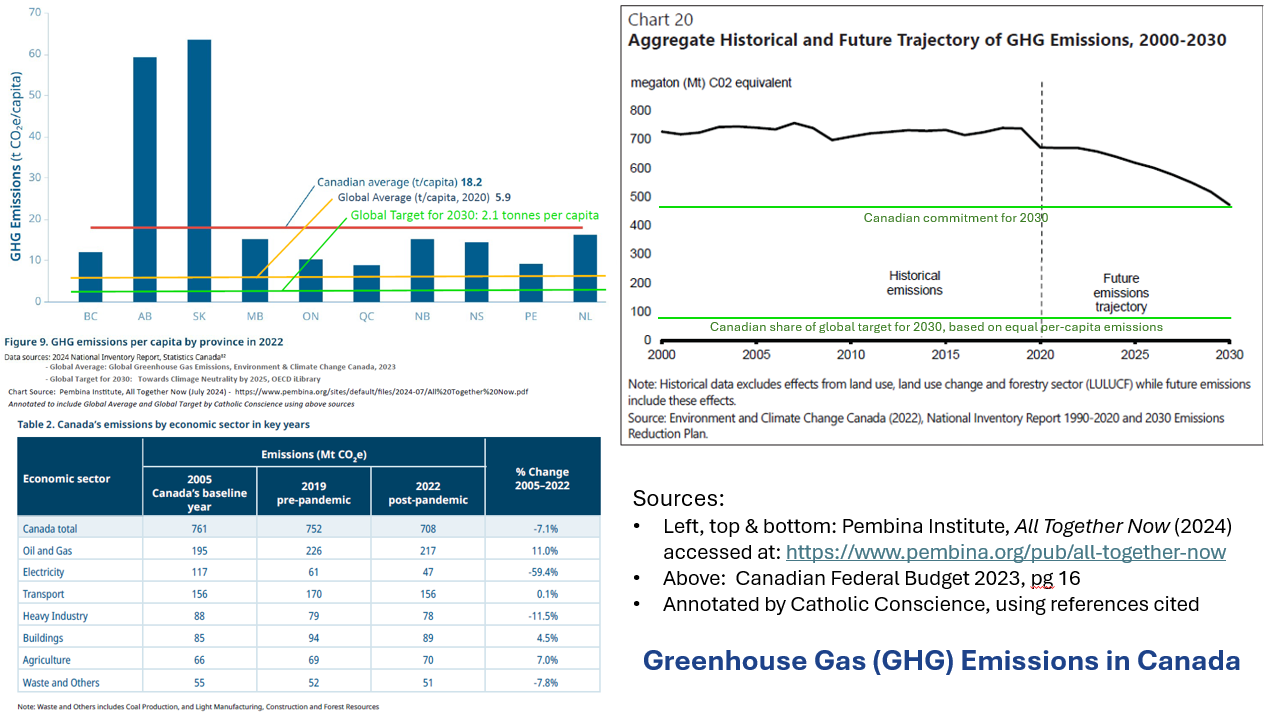
The charts below show different aspects of GHG emissions in Canada, using the most recent data available. They provide rich ground for reflection on the application of Catholic Social Teaching. The first chart, labeled “Figure 9“, shows emissions per person in each province, by province, according to the most recent data. The second, labeled “Table 2”, shows the levels of emissions for various industries as of 2005 (the “benchmark” year by which most international GHG comparisons are measured), 2019, and 2022. The third, “Chart 20”, shows the federal government’s understanding of past emissions levels, and predictions for getting to its agreed level by 2030.
• Emissions in B.C.: Figure 9, the per-capita provincial comparisons, suggests that on a per-person basis B.C. is the lower provincial emitters in Canada, with emissions well below the current Canadian national average of 18.2 tonnes per person. It would appear, however, that work remains to be done if B.C. wishes to catch up with the current global average of 5.9 tonnes per person per year (the gold line in Figure 9), and even more if it wishes to reach the global target for 2030, of 2.1 tones per person per year (the green line).
* What, if anything, can or should fairly be done by the people of B.C. to join a global drive to reduce emissions levels?
* What, if anything, can or should fairly be done by the other provinces, and/or the federal government? Can or should B.C. do anything to help other provinces, including for example Alberta and Saskatchewan, whose higher levels of emissions are largely driven by processes that result in products that are shipped to other provinces?
• Industrial Emissions: Table 2 suggests both encouraging and disappointing trends in various industries. For example, it suggests that Canada-wide emissions caused by the generation of electricity have been reduced by more than half, while significant progress has been made in other heavy industries. On the other hand, emissions in the oil and gas, agricultural, and buildings sectors have continued to rise. What can or should be done about that by individuals and the provinces they live in, bearing the principles of subsidiarity, solidarity, the common good, and the sanctity of life in mind?
• Canada’s Fair Share: Chart 20 seems to present a challenge for all Canadians, wherever we life.
* For example, it is disappointing to see that emissions levels for the first 20 years shown in the chart have remained relatively constant, with the bulk of the reductions being predicted for the last 10 years. It seems disappointingly common for curves on social phenomena to show the bulk of the progress in the future, while little improvement has been made in the years since commitments were made or is predicted for the nearer future. Must that always be so? Assuming that it is true in this case, can or should we do better?
* The chart also seems to suggest that even if we meet Canada’s 2030 goal as a nation, we all have much work to do beyond that: our nation has committed only to reduce emissions to a point at which we are producing about six times as many emissions as the rest of the world. Assuming that is true, can or should we do better?
• Fewer parties are committing in platform statements to holistic approaches to preservation of the environment, opting instead to indirectly promise improvement on emissions, clean water, and conservation, as parts of efforts to improve the economy. Is that prudent? Is it fair to those who depend on the environment for food, or for breathing? Is it fair to future generations?