
Of Common Concern: Just War, Revisited
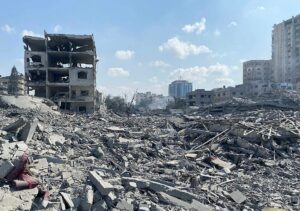
The eruption of new conflicts in the Caribbean and in Western Asia suggests that debate over Just War doctrine will remain active for the foreseeable future. Current debate suggests several points to ponder.
As explained in our previous Just War posting, classic Catholic doctrine imposes strict conditions on the use of military force, even in defense. Among other criteria, in the Catholic view all other options must be exhausted before resort to violence can even conceivably be justified. (Catechism 2302-2308). This was strongly reinforced in Fratelli tutti. Pope Francis pointed out that in practice war is often started by aggressors:
...invoking all sorts of allegedly humanitarian, defensive or precautionary excuses, and even resorting to the manipulation of information. In recent decades, every single war has been ostensibly “justified…” [A critical] issue is whether the development of nuclear, chemical and biological weapons, and the enormous and growing possibilities offered by new technologies, have granted war an uncontrollable destructive power over great numbers of innocent civilians. The truth is that never has humanity had such power over itself, yet nothing ensures that it will be used wisely. We can no longer think of war as a solution, because its risks will probably always be greater than its supposed benefits. In view of this, it is very difficult nowadays to invoke the rational criteria elaborated in earlier centuries to speak of the possibility of a ‘just war.’ Never again war! (1)
Points to Ponder:
- Several justifications for US and Israeli intervention in Iran have been offered to the public, including imminent military threats posed by Iran, regional aggression on the part of Iran, and prophetic religious grounds. Similarly, the threat of narco-terrorism was cited in support of US intervention in Venezuela. Importantly, in each case ex-patriates and other natives of the target countries have voiced support for the intervenors’ vigorous action, citing long-standing maltreatment of local citizens and the utterance and realization of various threats.In each case, however, it is also true that each of the cited grounds has been questioned, sometimes at apparent personal cost to those who refute them.For example, it is widely reported that the director of the US National Counter-terrorism Center resigned on grounds of conscience, noting that no imminent threat to the US existed. Likewise, it is reported that shortly before direct US intervention in Venezuela, a senior US Navy admiral took voluntary early retirement. Others have criticized the interventions on legal grounds, while Pope Leo XIV has pleaded for peace and efforts to avoid a spiral of violence. (2)How can the justifications offered be considered fairly? For example:
- Under classical Catholic Just War doctrine, can pre-emptive attacks ever be justified?
- Does the fact that multiple justifications, each of them in turn disputed, were offered after the fact, help or hurt the cases offered for pre-emptive strikes?
- If it is possible to justify such attacks under classic doctrine, do the clarifications offered by Pope Francis alter the analysis?
- As noted, in some cases the legality of the attacks under national laws has been questioned.(2) How do universal moral and national legal requirements relate to one another?
- Under classical Catholic Just War doctrine, can pre-emptive attacks ever be justified?
- Estimates of both the human and economic effects of the war vary widely. (3)For example, the US and Israel report the deaths of approximately 30 of their own soldiers, and several thousand deaths among civilians, many of them among Arab neighbours of the combatants. Iran is reported to have suffered approximately 6,000 deaths, military and civilian. In Venezuela, dozens of people were killed, apparently in order to effect two extraordinary arrests. Between the two actions, economic damage is reported to exceed tens or potentially even hundreds of billions of dollars. Environmental damage has not yet been reliably assessed.
- Do the number of reported deaths affect your conclusions about stated justifications for the attacks? What about economic or environmental costs?
- Human losses would not appear to be fully compensable in this life, meaning that judgment for those will reside with Christ.
- Who will bear the economic and environmental costs? Will they be borne by the same people who have incurred them, or passed to others?
- Do the number of reported deaths affect your conclusions about stated justifications for the attacks? What about economic or environmental costs?
- In the Iran conflict, both sides have used robotic and remotely-controlled weapons in their strikes, including weapons programmed to target specific individuals. In several cases, such attacks have resulted in the “collateral” deaths of individuals who were not specifically targeted, but who happened to be close to the intended targets.
- Can the use of robotic weapons be justified? Can targeted military or political assassination be justified? Do “collateral” deaths of innocent bystanders matter to your answer?
- In the Democratic West, reports of the ongoing effect of the war have sometimes tended to focus on domestic prices for commodities such as gasoline and food. (5)
- Does Catholic social doctrine support consideration of the price of local consumer commodities to justify wars that are reported to have killed thousands of people?
- To the extent that violent military intervention has not been justified, and given that several of the stated grievances would seem to bear weight, what non-violent alternatives might be available to the various parties to the conflict?
- What would Christ say about the interventions? Would his remarks recorded at Matthew 5:17-20; 38-48 have any relevance?
References:
(1) Pope Francis, Fratelli tutti, 258
(2) See, for example,
- https://www.cnn.com/2026/03/17/politics/joe-kent-resigns-iran-war;
- https://www.aljazeera.com/news/2026/3/18/who-is-joe-kent-and-why-did-he-resign-as-trumps-counterterrorism-chief
- https://www.democracynow.org/2026/4/1/palestinian_christians_west_bank
- https://www.vaticannews.va/en/pope/news/2026-03/pope-leo-xiv-angelus-appeal-peace-middle-east-iran.html
(3)See, for example,
- https://www.oxfordeconomics.com/resource/the-2026-iran-war-an-initial-take-and-implications
- https://www.reuters.com/world/middle-east/iran-conflict-poses-new-risk-us-economic-resilience-2026-03-02
- https://www.middleeasteye.net/live-blog/live-blog-update/iea-chief-world-faces-greatest-global-energy-security-challenge-history
- https://www.janes.com/osint-insights/defence-and-national-security-analysis/iran-conflict-2026-disruption-to-strait-of-hormuz-increases-energy-and-food-production-risks
(4) See, for example,
- https://www.theguardian.com/business/2026/mar/02/middle-east-crisis-oil-prices-inflation-us-iran-interest-rates-growth
(5) See, for example,
- https://www.axios.com/2026/04/01/oil-prices-200-barrel-strait-hormuz?utm_source=newsletter&utm_medium=email&utm_campaign=newsletter_axiosgenerate&stream=top
- https://www.theguardian.com/business/2026/mar/02/middle-east-crisis-oil-prices-inflation-us-iran-interest-rates-growth