
 Church Teaching
 The Proper Role of Government
It is impossible to understand the role and purpose of government and other social institutions without first appreciating the purpose of life.
If, as the Church believes, the purpose of life is for each soul to search for and find the truth which is God, and to seek to grow closer to God, and to ensure that all other souls are encouraged and enabled to find their own ways to God, it follows that the proper role of government is to provide, with the support of the Church and other moral, educational, and economic institutions, a legal and economic framework in which the common good can flourish, in order that the people may accomplish their mission, that is, so that the people may use the freedom God has given them to seek the truth and thereby return to Him.
An authentic democracy is not merely the result of a formal observation of a set of rules but is the fruit of a convinced acceptance of the values that inspire democratic procedures: the dignity of every human person, the respect of human rights, commitment to the common good as the purpose and guiding criterion for political life. If there is no general consensus on these values, the deepest meaning of democracy is lost and its stability is compromised.
The Church’s social doctrine sees ethical relativism, which maintains that there are no objective or universal criteria for establishing the foundations of a correct hierarchy of values, as one of the greatest threats to modern-day democracies. – 407, Compendium of the Social Doctrine of the Church
Responsibilities of the State include:
– ensuring that all individuals are enabled to achieve their full potential, by maintaining a framework capable of providing all the material, moral, and spiritual goods necessary for the common good
– harmonizing the different interests of sectors of society with the requirements of justice, including particularly the reconciliation of private ownership of goods with the common good
– ordering society not only in accordance with the desires of the majority, but the effective good of all the members of the community, including minorities
– 168, Compendium of the Social Doctrine of the Church
Stewardship of Office
Public administration at any level — national, regional, community — is to be oriented towards the service of citizens, serving as steward of the people’s resources, which it must administer with a view to the common good.
Tax revenues and public spending take on crucial economic importance for every civil and political community. The goal to be sought is public financing that is itself capable of becoming an instrument of development and solidarity. Just, efficient and effective public financing will have very positive effects on the economy, because it will encourage employment growth and sustain business and non-profit activities and help to increase the credibility of the State as the guarantor of systems of social insurance and protection that are designed above all to protect the weakest members of society.
Public spending is directed to the common good when certain fundamental principles are observed: the payment of taxes as part of the duty of solidarity; a reasonable and fair application of taxes; precision and integrity in administering and distributing public resources.
In the redistribution of resources, public spending must observe the principles of solidarity, equality and making use of talents. It must also pay greater attention to families, designating an adequate amount of resources for this purpose. In the democratic system, political authority is accountable to the people. 355, 408, 412, Compendium of the Social Doctrine of the Church
Democratic Reform
Representative bodies must be subjected to effective social control. This control can be carried out above all in free elections which allow the selection and change of representatives. The obligation on the part of those elected to give an accounting of their work — which is guaranteed by respecting electoral terms — is a constitutive element of democratic representation.
Among the deformities of the democratic system, political corruption is one of the most serious. If there is no ultimate truth to guide and direct political action, then ideas and convictions can easily be manipulated for reasons of power. A democracy without values easily turns into totalitarianism. – 406-412, Compendium of the Social Doctrine of the Church
Cooperation and respect between parties
Political parties have the task of fostering widespread participation and making public responsibilities accessible to all. Political parties are called to interpret the aspirations of civil society, orienting them towards the common good… An authentic democracy is not merely the result of a formal observation of a set of rules but is the fruit of a convinced acceptance of the values that inspire democratic procedures: the dignity of every human person, the respect of human rights, commitment to the common good as the purpose and guiding criterion for political life. If there is no general consensus on these values, the deepest meaning of democracy is lost and its stability is compromised. – 407, 413, Compendium of the Social Doctrine of the Church
Peace & Good Order
Peace & International Relations
Because of the new bonds of interdependence among global operators, the traditional defensive measures of States appear to be destined to failure.
The centrality of the human person and the natural inclination of persons and peoples to establish relationships among themselves are the fundamental elements for building a true international community, the ordering of which must aim at guaranteeing the effective universal common good… [T]he unity of the human family is not yet becoming a reality. This is due to obstacles originating in materialistic and nationalistic ideologies that contradict the values of the person integrally considered in all his various dimensions, material and spiritual, individual and community. In particular, any theory or form whatsoever of racism and racial discrimination is morally unacceptable. The coexistence among nations is based on the same values that should guide relations among human beings: truth, justice, active solidarity and freedom…. Compendium of the Social Doctrine of the Church, 370, 433
Global care for the environment
Responsibility for the environment should also find adequate expression on a juridical level. It is important that the international community draw up uniform rules that will allow States to exercise more effective control over the various activities that have negative effects on the environment and to protect ecosystems by preventing the risk of accidents… They must be accompanied by a growing sense of responsibility as well as an effective change of mentality and lifestyle. Compendium of the Social Doctrine of the Church, 467, 468
Peacekeeping & Embargoes
States do not always possess adequate means to provide effectively for their own defence. From this derives the need and importance of international and regional organizations, which should be in a position to work together to resolve conflicts and promote peace, re-establishing relationships of mutual trust that make recourse to war unthinkable.
The purpose of sanctions must be clearly defined and the measures adopted must from time to time be objectively evaluated by the competent bodies of the international community as to their effectiveness and their real impact on the civilian population. The true objective of such measures is open to the way to negotiation and dialogue. Sanctions must never be used as a means for the direct punishment of an entire population. Economic sanctions in particular are an instrument to be used with great discernment and must be subjected to strict legal and ethical criteria. An economic embargo must be of limited duration and cannot be justified when the resulting effects are indiscriminate. Compendium of the Social Doctrine of the Church, 499, 507
Displaced Persons & Humanitarian Aid
A particular category of war victim is formed by refugees, forced by combat to flee the places where they habitually live and to seek refuge in foreign countries. The Church is close to them not only with her pastoral presence and material support, but also with her commitment to defend their human dignity: Concern for refugees must lead us to reaffirm and highlight universally recognized human rights, and to ask that the effective recognition of these rights be guaranteed to refugees.
It is therefore essential to seek out the causes underlying bellicose conflicts, especially those connected with structural situations of injustice, poverty and exploitation, which require intervention so that they may be removed. For this reason, another name for peace is development. Just as there is a collective responsibility for avoiding war, so too there is a collective responsibility for promoting development. Compendium of the Social Doctrine of the Church, 158, 498, 515
Finance
In the presence of new areas of competition, the very notion of a national market recedes into the background. If the creation of what is called the “global capital market” has brought benefits… on the other hand it has also increased the risk of financial crises. The financial sector, which has seen the volume of financial transactions far surpass that of real transactions, runs the risk of developing according to a mentality that has only itself as a point of reference, without being connected to the real foundations of the economy.
The more the worldwide economic-financial system reaches high levels of organizational and functional complexity, all the more priority must be given to the task of regulating these processes, directing them towards the goal of attaining the common good of the human family. Compendium of the Social Doctrine of the Church, 368-371
Trade
The Church has time and again called attention to aberrations in the system of international trade, which often, owing to protectionist policies, discriminates against products coming from poorer countries and hinders the growth of industrial activity in and the transfer of technology to these countries.
The continuing deterioration in terms of the exchange of raw materials and the widening of the gap between rich and poor countries has prompted the Church to point out the importance of ethical criteria that should form the basis of international economic relations: the pursuit of the common good and the universal destination of goods; equity in trade relationships; and attention to the rights and needs of the poor in policies concerning trade and international cooperation.
Economic and social imbalances in the world of work must be addressed by restoring a just hierarchy of values and placing the human dignity of workers before all else. Compendium of the Social Doctrine of the Church, 370, 321, 364
Disarmament
The Church proposes the goal of general, balanced and controlled disarmament. The enormous increase in arms represents a grave threat to stability and peace. The principle of sufficiency, by virtue of which each State may possess only the means necessary for its legitimate defence, must be applied both by States that buy arms and by those that produce and furnish them. Any excessive stockpiling or indiscriminate trading in arms cannot be morally justified.
The doctrine of deterrence gives rise to strong moral reservations. The arms race does not ensure peace. The principle of the non-proliferation of nuclear arms, together with measures of nuclear disarmament and the prohibition of nuclear tests, are intimately interconnected objectives that must be met as soon as possible by means of effective controls at the international level. Compendium of the Social Doctrine of the Church, 508-509
Arms Sales
War is a scourge and is never an appropriate way to resolve problems that arise between nations. Appropriate measures are needed to control the production, sale, importation and exportation of small arms and light weapons, armaments that facilitate many outbreaks of violence to occur. The sale and trafficking of such weapons constitute a serious threat to peace: these arms kill and are used for the most part in internal and regional conflicts; their ready availability increases both the risk of new conflicts and the intensity of those already underway. The position of States that apply severe controls on the international transfer of heavy arms while they never, or only very rarely, restrict the sale and trafficking of small arms and light weapons is an unacceptable contradiction. Compendium of the Social Doctrine of the Church, 497-511
Criminal Justice & Public Safety
In order to protect the common good, the lawful public authority must exercise the right and the duty to inflict punishments according to the seriousness of the crimes committed. The State has the twofold responsibility to discourage behaviour that is harmful to human rights and the fundamental norms of civil life, and to repair, through the penal system, the disorder created by criminal activity…
Punishment does not serve merely the purpose of defending the public order and guaranteeing the safety of persons; it becomes as well an instrument for the correction of the offender. There is a twofold purpose here. On the one hand, encouraging the reinsertion of the condemned person into society; on the other, fostering a justice that reconciles, a justice capable of restoring harmony in social relationships disrupted by the criminal act committed. – 402 Compendium of the Social Doctrine of the Church
 Liberal Party of Newfoundland and Labrador
 Party Values & Purpose of Government
The party’s constitution states that:
-all individuals should be treated with dignity.
-it strives for an inclusive society in which every individual is valued equally under the law and has an equal opportunity to reach their full potential.
-a fundamental core Liberal value is a fair balance between respect for individual rights and freedoms and caring for the needs of each individual and of society as a whole.
-its members are committed to openness and transparency in government and the opportunity for all to participate in the political process.
In its 2021 mandate letters, the party instructed its each of its ministers:
-to remain always focused on a robust economy where there is a place for all workers, an economy that embraces renewable energy while maximizing the provinces oil and gas advantage; including fostering a business environment that supports new and growing technology work while reimagining and reinvigorating provincial fishing and mining sectors to meet global demand for its abundant resources.
-while building a strong economy, work also to create a prosperous society, healthy, active residents who not only have access to the means to treat illness but also to achieve wellness, with vibrant, engaged communities in which nobody is left behind while also building both economic and social, environmental, and cultural wealth.
-to remain always mindful of the needs of the most vulnerable in provincial society and ensuring that quality social services are available and accessible to Newfoundlanders and Labradorians.
-in meeting these needs, to integrate a Gender-Based Plus Analysis into all policies and proposals.
Taxes, Services, Stewardship & Reform
Fiscal responsibility
The party’s most recent platform statement (dated 2019) states that:
-during its prior term in office, as the province battled its way out of a tough financial situation during challenging economic times, it was spending over $1 billion per year on servicing the province’s existing debt.
-it undertakes to responsibly manage debt, and to take steps to improve its debt management, including engaging best practices and financial experts, consolidating debt across Government entities, and rolling over expensive debt from past years to more affordable arrangements.
-given the Province’s current debt burden of over $16 Billion and with an annual deficit of $1.8 Billion, its plan for the province during its prior term in office was focused on economic and social growth that would make real improvements in people’s lives without further jeopardizing the province’s financial footing. Many of the ideas in its plan would be funded by Reinvested Savings (RS).
-it would also seek opportunities to modernize the Financial Administration Act to help the Province meet its debt requirements today, while allowing the province to reduce the overall debt load tomorrow.
The party’s 2021 provincial budget projected deficits at the following levels through 2026, with a target surplus position by 2026-27:
*2021-22 $826 million
*2022-23 $587 million
*2023-24 $377 million
*2024-25 $314 million
*2025-26 $88 million
The party’s 2025 budget provides the following summary of the financial health of the province:
-provincial deficit decreased during its term in office from $1.5 billion in 2020-21 to $372 million estimated in 2025-26.
-contributions of $108 million to the Newfoundland and Labrador Future Fund to bring the total contributions to $467 million. Cumulative Future Fund contributions to 2029-30 are forecast to be $1.3 billion. This investment will be used for debt repayment and future opportunities.
-during 2024-25, placed first transactions in the European capital market, building upon the launch of the European borrowing program at the London Stock Exchange.
-strengthened liquidity, so that cash reserves are available to meet obligations.
-signed a Memorandum of Understanding with Québec to terminate and replace the 1969 Upper Churchill Contract, develop Gull Island and expand capacity of the Churchill Falls plant. This will result in more than $225 billion in total revenue to the provincial treasury over the life of the agreements.
-projects the following revenue and expense totals for 2025-2030:
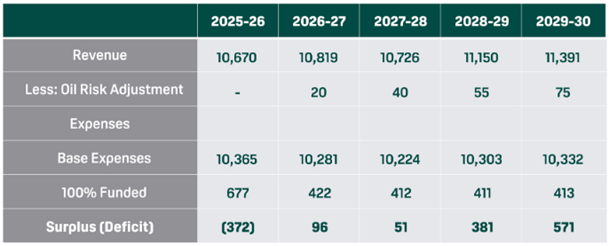
Source: Newfoundland and Labrador Budget 2025
Democratic reform
In its 2021 mandate letter, the party instructed the Minister of Justice and Public Safety to lead a review of the elections act in order to develop modern legislation that ensures accessible voting for the people of the province, and collaborate with the Government House Leader to lead democratic reform efforts.
Intergovernmental Relations
Communities
The party’s most recent platform statement (dated 2019) states that:
-the community sector plays a vital role, delivering significant and lasting social and economic value to communities across the Province. The sector employs more than 16,000 Newfoundlanders and Labradorians, and delivers wide-ranging support to people and communities.
-it advocates working with high-potential organizations whose impact can be scaled, harnessing their economic and social benefits, including creation of an incubator and accelerator to spark, grow, and enhance the community sector and drive social innovation, complemented by holistic support of the community sector.
Strong and sustainable municipalities
The party’s most recent platform statement (dated 2019) states that:
-sustainable communities are the building block of the province. Local governments provide services closest to home for Newfoundland and Labrador.
-during its term in office it increased support for municipalities, and will continue to collaborate with stakeholders to ensure they remain strong and sustainable.
-advocates incentivizing communities exploring regionalization and seeking to share services, thereby reducing costs and improving outcomes, and to that end will continue to partner with municipalities and the Federal Government to ensure sustainable communities across Newfoundland and Labrador.
-to empower councils and ensure accountable local leadership, it undertakes to introduce modern municipal legislation, based on extensive consultations with stakeholders.
The party’s 2025 Budget Speech states that in order to support municipalities and help provide important services to residents, the party has allocated:
-$187.5 million for funding programs and grants, including Municipal Operating Grants, Special Assistance Grants, the Community Enhancement Employment Program; Provincial Gas Tax, and the Canada Community Building Fund.
-$225,000 for volunteer firefighter training.
-$508,000 for drinking water improvement initiatives.
-$350,000 for initiatives to support the 2025 general Municipal Election.
-$100,000 for wastewater monitoring.
-$75,000 to help mark the 100th anniversary of women achieving the right to vote and hold public office.
-for community-based organizations that contribute to the social and economic well-being of communities, more than $100 million in grants.
-to build upon $382.6 million allocated over the last five years for close to 750 heavy civil projects including water, sewer, and roads infrastructure, support for projects currently in active construction, and 280 projects totalling $334 million in approval or design phase.
Courts & Public Safety
The party’s most recent platform statement (dated 2019) states that:
-the support and development of modern correctional practices is crucial to positive outcomes of those in the criminal justice system.
-it advocates construction of a new penitentiary set to start in 2022 and be completed by 2024-25, and implementation of enhanced programming, recreation and mental health services to better support the inmates and improve working conditions for employees.
The party’s 2025 Budget speech states that it has allocated:
-$32.8 million allocated over the next two years to redevelop the Martin Gallant Building in Stephenville Crossing.
-$17.5 million to continue the procurement of the replacement of Her Majesty’s Penitentiary and address temporary infrastructure enhancements until the replacement.
-$4.5 million to complete the redevelopment of the Labrador Corrections Facility
Restorative Justice
The party’s latest platform statement (dated 2019) states that:
-it believes that the core of a caring, civil society is developing authentic relationships and empathy with others. The Government of Canada incorporates restorative justice options and practices as part of the criminal justice system, but restorative justice in education deals with developing foundational relationships as a way of being. Many educational institutions have begun implementing restorative justice practice as part of a holistic student and faculty approach to improving the school climate, developing meaningful relationships and enhancing the learning environment of the school.
-the Little Book of Restorative Justice in Education defines RJE as …facilitating learning communities that nurture the capacity of people to engage with one another and their environment in a manner that supports and respects the inherent dignity and worth of all (Evans & Vaandering, Restorative Justice in Education, 2016).
-it is committed to working further with the expertise established at Memorial University to enhance teacher training in restorative justice principles. It will work to further implement these principles into all our Province’s schools to nurture healthy relationships built on foundational respect for all members of the school community and support the development of policies and practices that reinforce inclusive behaviour.
The party’s 2025 budget speech states that:
-the Policing Transformation Working Group, and its extensive engagement with community partners, continues to advise on best practices for enhancing public safety and meeting the evolving needs of provincial communities. Nearly $20 million has been invested over two years to bolster new public safety initiatives, in addition to the $40 million the party added to the budget over the last five years, which has been applied toward establishment of a Joint-Task Force Unit comprised of RNC and RCMP officers to target weapon, drug, and contraband enforcement and critical incident response activities.
-over $180 million is allocated annually for policing services in Newfoundland and Labrador.
-Budget 2025 provides five new RCMP officers in Happy Valley-Goose Bay and 10 new RNC officers for the Northeast Avalon, as well as ongoing police training, the provision of essential equipment, fleet enhancements, and operational requirements.
-$3.4 million is being allocated as part of a $24 million investment for new tools and technologies to improve efficiency, as well as 25 new Correctional Officers; 18 new Crown attorneys; 14 new Deputy Sheriffs and a Manager of court security for Labrador.
-allocates $3.7 million for fire protection vehicles and equipment, and $3.5 million in disaster emergency assistance, to help residential homeowners and tenants, small businesses, not-for-profit organizations and cooperatives, local authorities and the public sector with uninsurable loss and damage caused by an eligible disaster.
-honours the culture and heritage of Indigenous Peoples and works to address such social determinants of health as education, violence prevention, and economic development through allocation of nearly $500,000 to help create safer Indigenous communities; and $5 million for the ongoing Inquiry Respecting the Treatment, Experiences and Outcomes of Innu in the Child Protection System.
Gender-based violence
The party’s 2025 Budget speech states that:
-through strong partnerships with community groups, progress is being made on the National Action Plan to End Gender-based Violence, which is in its third year. For 2025 more than $3.6 million is allocated for continued focus on the safety and security of women, Indigenous Peoples, and gender-diverse individuals. These efforts are pivotal in addressing the social determinants of health for these communities.
-in addition, more than $3 million is allocated annually for community organizations, for building community support networks.
-in addition, a Sergeant position has been established within the RNC dedicated to this critical issue, and a new civilian victim services navigator position has been created for the RNC’s intimate partner violence unit, supported through the Office of Women and Gender Equality.
 Ontario New Democratic Party
 Party Values & Purpose of Government
The party’s constitution states that its objectives are to promote principles of social democracy, namely:
-belief that the social, economic, and political progress of Newfoundland and Labrador can be assured only by the application of social and egalitarian principles to the governance and administration of public affairs.
-directing production of goods and services to meeting the social and individual needs of people within a framework of economic and environmental sustainability.
-accepting that the dignity and freedom of the individual is a basic right that must be maintained and extended to all persons regardless of race, ethnic background, ability, religion, gender, or sexual orientation.
-accepting that abolition of poverty and elimination of exploitation are achievable goals and must be a priority of any thinking and compassionate government.
-the right of the people to a meaningful voice in public policy through consultation and participation at all levels of public decision-making.
-the right of voters to representative and participatory democracy through proportional representation.
Taxes, Services, Stewardship & Reform
Revenue
The party’s latest published policy statement (dated 2021) states that it advocates:
-increasing royalty payments for natural resource extractors by an additional 3% per annum, and increasing their corporate tax rates to 20% immediately.
Services
The party’s latest published policy statement (dated 2021) states that it adamantly opposes dismantling of public services and selling off of public assets.
Municipal Elections
The party’s latest published policy statement (dated 2021) states that it:
-supports reform of legislation governing municipalities, including working with municipal governments and community organizations to strengthen municipal autonomy to set electoral standards, including strengthening of finance laws, enfranchisement for permanent residents, and allowing alternatives to the first-past-the-post voting system.
Courts & Public Safety
Sex workers
The party’s latest published policy statement (dated 2021) states that:
-it will commit to the belief that sex work is work, sex workers are workers and people, and sex workers’ rights are human rights to be protected under the Charter of Rights and Freedoms.
-it will commit to amend and/or repeal any and all provincial laws and regulations relevant to sex work.
-it will work to better the lives of those who participate and are directly involved in the sex industry, including but not limited to improving the safety, security, and social and economic well-being of sex workers in the province.
-it will commit to increased funding for non-profit organizations which provide ongoing non-judgmental support, harm reduction, and resources to those who formerly or currently do sex work, and t those who continue to do sex work without being pressured to exit their choice of work.
-it will commit to lobbying for changes to relevant municipal and federal legislation and regulations to reflect the goals stated above.
Cannabis
The party’s latest published policy statement (dated 2021) states that it supports:
-banning use of urine or hair follicle tests in provincial workplaces, as they discriminate against medicinal and recreational users of cannabis; and exploring us of saliva testing, sobriety field testing, or future technologies to better determine workplace intoxication.
-allowing bars/lounges for the safe consumption of cannabis for adults of legal age.
 Progressive Conservative Party of Newfoundland and Labrador
 Party Values & Purpose of Government
The party’s constitution (dated 2020) states that:
-that the mission of the party shall include promoting democracy and advancing the core values and policies of the party.
-core values of the party include:
* justice, respect, and freedom.
*openness, transparency and accountability.
*fiscal responsibility.
*sound economic management.
*diversity.
*progressive social policy.
The party’s most recent platform publication (dated 2019) identifies three pillars supporting its policy proposals:
-jobs and hope.
-affordable living.
-honest leadership.
Taxes, Services, Stewardship & Reform
Reform
The party’s most recent platform publication (dated 2019) states that:
-Canadian activists have put forward a list of issues they believe any jurisdiction that’s serious about democratic reform should address – issues such as honesty in politics, oversight, government hiring, public consultation legislation, political donations, conflict of interest, lobbying, electoral reform, access to information and fiscal management.|-if these changes were made by any government in any jurisdiction, it would become the world’s leading democratic jurisdiction.
-the party advocates reform in all these areas.
Electoral Promises and Performance in Office
The party’s most recent platform publication (dated 2019) states that it undertakes to:
-enact Canada’s first Honesty in Politics Law to hold politicians accountable for promises made which voters reasonably take as solemn and intended to be relied on.
– enact ‘recall’ legislation to enable constituents to remove a Member.
Parliamentary Question & Answer Period
The party’s most recent platform publication (dated 2019) states that it undertakes to:
-require Ministers to answer questions posed to them, and drive the process to reform the Standing Orders of the House of Assembly to make Question Period more accountable as an Answer Period.
-forbid political parties from ‘whipping’ the vote for Speaker.
-press for the acceptance of digital signatures on petitions to the House of Assembly.
Electoral reform
The party’s most recent platform publication (dated 2019) states that it undertakes to:
-reform fixed-date election legislation to respect the principle of providing adequate advance notice for elections while ensuring prospective candidates have adequate time to prepare. The provision in the existing House of Assembly Act that, in effect, permits the Premier to call an election at any time will be repealed.
-explore options to ensure women, Indigenous communities and minorities are better represented in the House of Assembly.
Code of Conduct & Accountability
The party’s most recent platform publication (dated 2019) states that it undertakes to:
-commission a review of the Members of the House of Assembly Code of Conduct to ensure it better reflects the people’s expectations of their elected Members.
-remove the Premier’s power to commission secret investigations of Members that are reported to the Premier directly but not to the House.
-prohibit political interference in harassment investigations.
-establish a cooling off period before lobbyists can work in key roles in the public service.
-replace the ‘smokescreen’ Independent Appointments Commission with a truly independent, transparent and accountable process for appointing people to senior roles in the public service, fully engaging the nonpartisan Public Service Commission.
-require the disclosure of key shareholders in numbered companies doing business with the government or benefiting from public funding.
-empower the Seniors’ Advocate to investigate and report, which the other officers of the House of Assembly have by law.
-lower ATIPPA costs by publishing more information proactively as a matter of course.
-publish a mandate letter for each Cabinet Minister and hold each Minister to account for fulfilling that mandate.
Public Consultations
The party’s most recent platform publication (dated 2019) states that it undertakes to:
-create a Public Consultation Act to define the duty to consult and describe the mechanisms.
-provide forums for citizens and groups to be consulted on their concerns and perspectives.
-make better use of digital communications technology to improve democratic engagement and information exchange.-establish a process to tap into the particular expertise of academic leaders.
-establish a process by which public employees can provide regular advice about ways to reform government operations and enhance accountability.
-consult with municipalities on ways to strengthen local decision-making and engagement.
-establish the mechanisms to inform the public of democratic governance issues.
-reform the law to allow citizen-initiated referendums and plebiscites, and the adding of ballot questions during a general election.
Intergovernmental Relations
The party’s most recent platform publication (dated 2019) states that:
-it advocates exclusion of non-renewable resource revenues from the calculation of transfer payments in the federal Equalization formula as is already done for revenues from hydroelectricity. The federal policy rewards a province like Quebec that earns revenue from the sale of hydroelectricity, and punishes Newfoundland and Labrador for revenues earned from offshore oil. This is artificial and unfair.
Courts & Public Safety Role & Purpose of Government
As one of its three policy pillars, the party’s most recent platform publication (dated 2019), identifies making life more affordable to assist in keeping young people in the province, including by:
-preventing violence through a renewed strategy for safer communities and homes.
-providing more moose fencing every year to save lives on provincial highways.
-developing a municipal fiscal framework as a foundation for municipal growth.
The party’s most recent platform publication (dated 2019) states that it undertakes to:
-toughen privacy protections to safeguard the private information of individuals and penalize those who disclose such information maliciously or through gross negligence.
-legislate to oversee and regulate the protection and use of voter data and personal information by provincial parties.
 Points to Ponder
 Points to Ponder: Good Government
Consider discussing the following with your local candidates, elected representatives, and the parties, and discussing with your family, friends, neighbors, coworkers, and fellow parishioners:
The Role and Purpose of Government
Catholics have definite ideas about the purpose of life and, arising from that purpose, the proper roles of civil society, government, and other social institutions. (https://catholicconscience.org/catholiccivics/)
- Are those ideas shared by most Canadians? If not, to what extent can or should we share our ideas with other Canadians? How should that be done?
- Are any values held in common by most Canadians? If so, what are they, and how do they inform the proper role of government and other social institutions? For example, what do we owe each other, and what does the answer mean for government, charities, schools, etc.?
- Is it important for a society to share common values? How can common values be promoted within a society?
The Government of Canada has recently published a Framework for Quality of Life (https://www160.statcan.gc.ca/infosheet-infofiche-eng.htm), and has instructed its ministers that “Across our work, we remain committed to ensuring that public policies are informed and developed through an intersectional lens, including applying frameworks such as Gender-based Analysis Plus (GBA Plus) and the quality of life indicators in decision-making.”
- To what extent is the Quality of Life framework consistent with the principles and values of Catholic social teaching?
- To what extent does, or should, a Quality of Life framework apply to provincial governance as well we federal?
Truth, Respect & Good Governance
Each of the mandate letters used by the federal government to instruct its ministers at the time the current government was formed explained that: “Canadians expect us to work hard, speak truthfully and be committed to advancing their interests and aspirations. When we make mistakes – as we all will – Canadians expect us to acknowledge them, and most importantly, to learn from them.”
- Has this standard been applied to provincial government in Newfoundland and Labrador?
- To the extent it has not, what can or should Newfoundland and Labrador voters do to encourage their governments to apply it?
It is an unfortunate and nearly universal practice for our political parties, in framing their platforms and policy statements, to focus at least as much on what’s wrong with the other parties as they do on what’s right about themselves.
- How can we, as citizens and voters, help encourage parties to look for common ground, speak positively and constructively about one another, and voice their suggestions for improvement in respectful and collaborative terms?
- How can we, as individuals, parishes, and as a Church, encourage responsible individuals to consider and accept political vocations in pursuit of truth, justice, and the common good? What roles can or should local, provincial, and federal governments play in promoting such callings?
Public Safety and the Responsibility to Protect
Since 2021, at least 85 Catholic Churches have been burned or vandalized in Canada (https://canadiancatholicnews.ca/as-churches-continue-to-burn-its-time-catholics-mobilized-politically/). Few such incidents have resulted in arrests, or even apparently seriously investigated. Yet all levels of government – municipal, federal, provincial – are responsible for the protection of citizens and their property. https://www.justice.gc.ca/eng/rp-pr/cp-pm/just/06.html ).
- Have governments in Canada met their responsibilities in protecting Catholics and others, including their rights to worship?
- Since at least 2005, member-nations of the United Nations including Canada, have accepted the principle of their responsibility to protect their citizens.(https://www.un.org/en/genocide-prevention/responsibility-protect/about) Have Canada and its provinces met their responsibilities to protect worshipers?
- To the extent governments have not met their duties, what can or should be done about it? How can or should Catholics encourage them to do so?
Contracting; Public – Private Partnerships
Contracting and cooperation between government and corporations or other private entities can be instrumental in accomplishing great common projects. On the other hand, unwatched they can become instruments of misuse.
- To what extent should public-private partnerships be allowed, for research, infrastructure development, or other purposes?
- What type(s) of entities should be considered when contemplating such partnerships? Local or foreign corporations? Non-profit or charitable organizations?
- How should such partnerships be monitored or regulated, in order to assure that arms-length relationships are maintained, and that principles of subsidiarity are respected?
Fiscal Responsibility
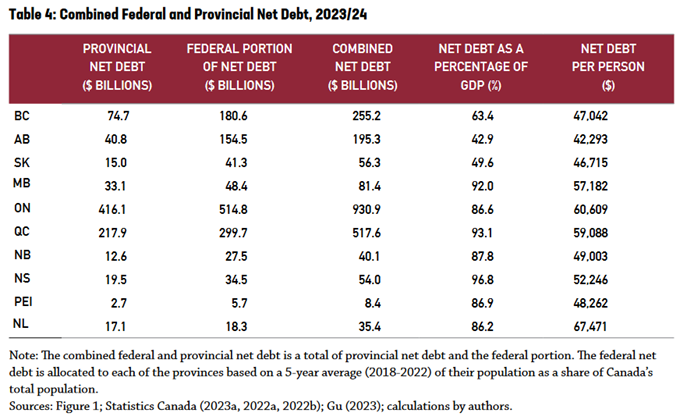
Table 4 below is taken from the report The Growing Debt Burden from Canadians: 2024 edition (©2024 Fraser Institute; https://www.fraserinstitute.org/sites/default/files/growing-debt-burden-for-canadians-2024.pdf). The report shows provincial and federal debts following the 2023/24 fiscal year, and suggests that between provincial and federal debt, taxpayers in Newfoundland & Labrador would appear to be liable for a debt of more than $67,000 per provincial resident, to be repaid at some future point as directed by the government.
The most recent report of the Auditor General (https://www.ag.gov.nl.ca/files/2024-Financial-Statement-Overview-Website.pdf) indicates that provincial debt has continued to rise in Newfoundland and Labrador, and that “the province should also plan to become less exposed to the increased cost of borrowing through conscious strategies to reduce its debt.”
- What do these figures tell citizens of Newfoundland and Labrador? Who will ultimately be responsible for satisfying public debt? Where will the money come from?
- The report suggests that citizens of Newfoundland and Labrador have the highest debt levels in Canada. Should voters or taxpayers be concerned? If so, what can or should they do about it?
- Should future generations of voters, taxpayers, or citizens be concerned? If so, what can or should they do about it?
© Fraser Institute, 2024