
 Church Teaching
The demands of the common good… are strictly connected to respect for and the integral promotion of the person and his fundamental rights. These demands concern above all the commitment to peace, the organization of the State’s powers, a sound juridical system, the protection of the environment, and the provision of essential services to all, some of which are at the same time human rights: food, housing, work, education and access to culture, transportation… -166, Compendium of the Social Doctrine of the Church
The Role & Development of the Family
“Honour your father and mother.”
– the 4th Commandment
The family is the primary unit in society. It is where education begins and the Word of God is first nurtured. The priority of the family over society and the State must be affirmed. – 209-214, Compendium of the Social Doctrine of the Church
The Church teaches that the proper role of government and other human institutions is to foster human life and dignity by maintaining social conditions that enable and encourage us to serve God in one another, and thereby to promote that which is truly in the common interest. This begins with nurturing and enabling families, as well as supporting the elderly and other marginalized members of society.
The Lord sets a father in honor over his children and confirms a mother’s authority over her sons. Those who honor their father atone for sins; they store up riches who respect their mother. Those who honor their father will have joy in their own children, and when they pray they are heard. Those who respect their father will live a long life; those who obey the Lord honor their mother. Those who fear the Lord honor their father, and serve their parents as masters. Sirach 3:2-7
Healthcare
Among the causes that greatly contribute to underdevelopment and poverty, mention must be made of illiteracy, lack of food security, the absence of structures and services, inadequate measures for guaranteeing basic healthcare, and the lack of safe drinking water and sanitation. -166, 447 Compendium of the Social Doctrine of the Church
Support for the Elderly
If the elderly are in situations where they experience suffering and dependence, not only do they need health care services and appropriate assistance, but and above all they need to be treated with love. – 222, Compendium of the Social Doctrine of the Church
Education
“May Nazareth remind us what the family is, what the communion of love is,
its stark and simple beauty, its sacred and inviolable character; may it help us to see how sweet
and irreplaceable education in the family is; may it teach us its natural function
in the social order. May we finally learn the lesson of work.”
– 210 Compendium of the Social Doctrine of the Church, citing St Paul VI, Address at Nazareth (5 January 1964)
Maintaining employment depends more and more on one’s professional capabilities. Instructional and educational systems must not neglect human or technological formation, which are necessary for gainfully fulfilling one’s responsibilities.
Young people should be taught to act upon their own initiative, to accept the responsibility of facing with adequate competencies the risks connected with a fluid economic context that is often unpredictable in the way it evolves. – 289, 290 Compendium of the Social Doctrine of the Church
Culture, Arts & Tourism
Faced with rapid technological and economic progress, and with the equally rapid transformation of the processes of production and consumption, a great deal of educational and cultural work is urgently needed. Compendium of the Social Doctrine of the Church, 376, 401
Certain economically prosperous countries tend to be proposed as cultural models for less developed countries; instead, each of those countries should be helped to grow in its own distinct way and to develop its capacity for innovation while respecting the values of its proper culture. A shallow and pathetic desire to imitate others leads to copying and consuming in place of creating, and fosters low national self-esteem.
We forget that “there is no worse form of alienation than to feel uprooted, belonging to no one. A land will be fruitful, and its people bear fruit and give birth to the future, only to the extent that it can foster a sense of belonging among its members, create bonds of integration between generations and different communities, and avoid all that makes us insensitive to others and leads to further alienation.” – Fratelli tutti, –51-53
 CentreBC
Role & Purpose of the Family
Child Care
In an online policy statement dated February 2026, the party advocates:
-treating child care as essential economic infrastructure to finally make the $10-a-day goal a reality for every family.
Health Care & Elder Care
Elder Care
In an online policy statement dated 16 Feb 2026, the party stated:
-it advocates expanding home care so that seniors can age with dignity, and reduce the paperwork for doctors so that they can focus on seeing patients.
Education & Young Workers
In an online policy statement dated February and September 2026, the party states that:
-it opposes repealing any legislation that would impact people’s rights to be be free from discrimination, whether as an employee or as a student.
-it advocates building a balanced, sustainable economy, championing existing industries and businesses, small and large, while fostering innovation to secure good jobs while modernizing the education system to prepare you for the future.
Artificial Intelligence in Education
In an online statement dated June 2026, the party advocates:
-ensuring that every student graduates AI literate; shifting curriculum to emphasize critical thinking, creativity, communication, ethical reasoning, adaptability, and resilience; establishing clear standards for responsible AI use in K-12 and post-secondary education; and investing in teacher training to support educators in leading this transformation.
Culture, Arts & Tourism
The party has published no current statement concerning its policies regarding culture, arts, or tourism.
 Christsian Heritage Party of BC
Role of the Family
The party states that:
– it believes that the family unit is essential to the well-being of individuals and society, because that is where children learn values and develop a sense of responsibility.
– therefore government legislation and programs should support and respect the role of the British Columbian family and the rich heritage of this province where the family unit has traditionally been valued and supported by government.
– it believes in the right and duty of parents to raise their own children responsibly according to their own conscience and beliefs. We believe no person, government or agency has the right to interfere in the exercise of that duty except through due process of law and only where it can be reasonably done.
Health Care & Elder Care
The party states that the Health Care System in British Columbia is not adequately meeting the needs of all British Columbians. There is currently a long waiting list for many medical procedures. In addition, many rural residents now have to travel long distances, sometimes in extreme winter conditions, to access certain types of health care.
The party therefore advocates:
– covering the cost of hospitals cost in British Columbia by payments from the Provincial Government on a “Performance” basis, to cause hospital administrations to become conscious of costs and revenues and help them to seek the most cost-effective way of dealing with their patients, and in many cases to offer more, rather than fewer services. This will help reduce waiting lists for surgeries
– when private health care providers can provide a service more cost effectively and/or in a more timely manner, sending patients to those private health care providers and covering the cost of their services through the BC Health Care system. This is currently being done with most doctors, who operate private, “for profit” clinics in British Columbia
– making copies of all invoices paid by the Provincial Government, including all payments to Government owned facilities as well as all payments to private health care providers available to the patient or surviving relative. This will enable the residents of British Columbia to see what their health care is costing the taxpayers and will make medical practitioners aware that their invoices are being seen by the customer
– creating an office of Provincial Surgeon General to oversee the complete provincial health care system and ensure fairness in payments to hospitals and clinics as well as to arbitrate patient complaints.
– addressing the shortage of doctors and nurses by fast tracking the accreditation of foreign trained professionals and by increasing the number of training spaces in provincial educational institutions
– encouraging the establishment of walk-in clinics, including clinics offering 24- hour service, and then encouraging emergency room personnel to refer non emergency patients to those walk-in clinics, where they can be treated more cost effectively
– opening or re-opening hospitals that have been closed in smaller communities in rural British Columbia, where numbers and/or distance from existing hospitals warrant, so that fewer patients will have to travel such great distances, sometimes in extreme weather, to access primary health care. This will also relieve some of the pressure on our regional hospitals. Where numbers warrant, palliative care will be provided at these small, rural hospitals so that those approaching end-of-life can be closer to their families and be kept comfortable.
– placing emphasis on preventative medicine and promoting fitness and nutrition as keys to healthier living and to reduce the demand on our health care facilities. This will include health and fitness programs in our schools, including mandatory physical education from K-12.
– establishing a Health Care Task Force that will consult with provincial health care professionals and residents, study health care services in other countries to determine what works and what could provide benefit to the residents of British Columbia
– ensuring that the five basic principles of the Canada Health Act are applied throughout Canada, even though the administration of health services comes under provincial jurisdiction. Residents of any province or territory who require medical assistance or services while visiting elsewhere in Canada should have as full and equal access to all health care facilities and services as residents of the province or territory in which the need for such services is required.
Abortion, Elective Surgery, & Socially-Assisted Death (SAD)
The party states that:
– while currently, abortions are performed by BC health care professionals both within provincially-operated facilities and private clinics, it does not believe abortions (the killing of tiny human beings) qualify as “health care”, or that BC taxpayers, many of whom are conscientiously opposed to abortion, should be forced to pay for them
– it also believes that the money spent on abortions in BC could be better spent on pregnancy care and support for new mothers. Many studies indicate negative health impacts for women who undergo abortions, including suicide, depression, birthing complications and a higher incidence of breast cancers.
– therefor the party advocates removing abortion from the list of taxpayer-funded surgical procedures
– the party further believes that BC taxpayers should not be forced to pay for any surgeries that are not medically necessary. (Abortion is an elective surgery and is not medically necessary).
– it advocates restoring the access to statistical information about abortions performed in all BC hospitals and private clinics, including making it mandatory to document all medical procedures in BC. This information must be available to the public through Freedom of Information requests.
– repealing provincial “Bubble Zone” legislation (Access to Abortion Services ACT of 1995) and restoring freedom of speech in BC.
– defending senior citizens and those with disabilities from attempts to institute euthanasia and assisted suicide in the province of BC.
Long-Term & Home Care
The party advocates
– opening more long term care facilities in British Columbia in order to get long term care patients out of our hospitals and into a more comfortable environment, and free up hospital beds for acute care patients
– opening more community care facilities in rural British Columbia, in order to take pressure off of our hospitals in those communities
– increasing the availability of home care support and reinstating housekeeping and other services so that more senior citizens can live in dignity in their own homes and so that that the demand for expensive hospital care will be further reduced
Education & Young Workers
Primary & Secondary Education
The party states that:
– parents are the first and primary educators of their own children. A CHP-BC Government will protect the right of parents to choose the best type of schooling for their children.
– provincial funding allocated for the education of BC children in primary and secondary schools “follow the student” and be directed to the school setting chosen by the parents. “School choice” means that the parents can choose the best school for their children and the provincial per-student allocation will be directed to that school, including public schools, charter schools, independent schools, or home schools.
– ensuring that the Ministry of Education establishes minimum academic standards to ensure that institutions or home schools are equipping students with adequate basic knowledge and skills, as well as a ‘fee per student’ that will apply to all students in BC.
– where institutions outside of the public school system are able to provide an equivalent or superior education at a lower cost, the Ministry will adjust fees accordingly for all students, providing an incentive for excellence and cost-effectiveness
– no schools funded by tax dollars will teach/promote/condone physical harm
– ensuring that volunteers and non-licensed paid employees are allowed to perform non-academic services for independent schools. Remuneration for these services will be entirely at the discretion of the governing body of the independent schools
– negotiating salaries and working conditions of public school teachers on a province wide basis
– ending the practice of taxpayer-funded BC Schools being used to promote social engineering regarding human sexuality, sexual orientation, etc. Parents are primarily responsible for training their own children in matters of morality. Public educators are entrusted—during the valuable time children are in their care and supervision—to support parents as role models, not to usurp their authority nor to undermine the values taught at home. To this end, reversing the Corren Agreement of 2005
– abandoning widespread promotion of “anti-bullying” as a strategy to promote alternate sexual and family models will be abandoned. All students will be protected from all forms of bullying, including pressure from teachers and peers to conform to new standards of sexual labelling and attitudes.
– promoting a high standard of conduct for all students and teachers including positive references to abstinence, chastity and marriage.
Post-Secondary Education
In order to promote employment and job creation, the party advocates:
– encouragement of and support for BC residents and support who wish to complete their education up to and including grade twelve
– within the ability of taxpayers to fund the cost, increasing provincial expenditures on education at technical institutes, colleges and universities by providing loans for students who apply and meet the minimum requirements. These loans will be forgivable for post-secondary students who graduate from BC institutions and continue to live, work and pay taxes in BC. Forgiveness of the loans will be pro-rated over a ten year period. If any graduate ceases to be a resident of British Columbia at any time within the ten years following graduation, the unforgiven pro-rated portion of the student loan will become due and payable
 Conservative Party of BC
Role and development of the family
The party’s 2025 Policy Declaration supports and recognizes that:
-parents have the right and responsibility to protect their children and must be protected when exercising those rights
-healthy family units benefit the whole of the province
-parents are the most important and significant factor in a child’s upbringing, and as such must have a protected sphere, without interference, to nurture and make decisions involving the child’s medical care, education, religious beliefs and moral upbringing.
Health Care & Elder Care
The party’s 2025 Policy Declaration states that:
-although the province spends more than 27 other comparable governments, it trails far behind when it comes to the number of acute care beds, doctors, MRI machines and other health care resources.
-it undertakes to review all aspects of health care policy, service, and delivery, including examining opportunities to increase efficiency and develop mechanisms to ensure health care decisions are made in the best interest of patients and taxpayers, based on population and demographics, cost effectiveness, and patient outcomes.
-it supports the basic principles of the Canada Health Act of Universality, including accessibility, comprehensiveness and portability; with the full understanding that the delivery of health care is a provincial responsibility in accordance with the Constitution of Canada.
-it supports the principles of transparency and public accountability in healthcare services, and of ensuring that health care boards represent regional population distribution and consider the local and regional health care needs.
-it advocates implementing a new “Patients First” healthcare model, including universal healthcare for everyone under a single-payer system that increases spending each year and delivers services through both public and non-governmental facilities.
-it advocates major and meaningful reform to expand access to care, end long wait times, and stop ER closures; to help all BC residents get family doctors, protect front line staff, address retention and recruitment issues, and create a modern and accountable system.
‘Patients First’ Healthcare Model
The party’s 2025 Policy Declaration advocates:
-ensuring that health care funding is focused on the best interests of patients and patient care, above all other interests.
-publicly-funded health care as the primary facilitator of health services in BC
-equal care for all BC residents, regardless of ability to pay
-allowing BC residents to have input to the type of care they want
-paying health care providers for diagnostic tests and other services when provided, rather than a standard practice of block grants
-implementing a Wait Time Guarantee for select diagnostic and surgical procedures, backed by an option for approval for reimbursed out-of-province care
-expanding publicly-funded partnerships with non-governmental clinics for specific priority procedures and diagnostic services, to reduce wait lists
-improving retention of health care staff by immediate re-hiring of thousands of staff who were forced out of work due to personal healthcare decisions and filling positions in high-need communities, and incentivizing doctors and nurses appropriately.
-prioritizing the privacy of patient health records
Wait times and Emergency Rooms
In an online policy statement dated 5 October 2026, the party states:
-British Columbians are paying more in taxes for healthcare, but waiting longer than ever for care. Despite promises made two years ago by the current government, more than a million British Columbians have no family doctor, and emergency rooms closed 2,400 times in two years. In 2025, the wait from referral to specialist treatment reached 32.2 weeks, the longest on record.
-the party undertakes to keep emergency rooms open, including hiring and retaining more doctors and nurses, supporting rural medical practices at risk of closing, and investing $50 million into an emergency fund, all while protecting current health care funding.
-it advocates training more doctors withing the province, bringing home Canadians who studied medicine abroad, and speeding up international credential recognition.
-within its first 100 days, launching an expert commission to bring proven solutions from other public systems to BC, while ensuring British Columbians never need anything more than their health card to get care.
Hospital and Healthcare Staff safety and support
The party’s 2025 Policy Declaration advocates:
-an immediate increase in security to protect healthcare workers and patients, including an immediate ban on weapons and all illicit drug use and drug dealing in BC emergency rooms and hospitals.
-providing paths for all front line staff, including Healthcare Assistants and licensed Practical Nurses, to upskill their credentials and advance their careers.
-training more doctors in BC by expanding capacity in the BC post-secondary system, presenting early offers and offfering multi-year contracts to BC-educated personnel, and increasing the number of residency positions within the province
-making it easier for healthcare professional educated in other countries to transfer credentials to the BC system
-investment in technology to reduce paperwork for physicians
-repealing the Health Professions and Occupations Act to de-politicize the medical professions
-ensuring that the BC health system participates in Artificial Intelligence health technologies
System Transparency and Accountability
The party’s 2025 Policy Declaration advocates:
-requiring healthcare providers to publish detailed statements of accounts on an annual basis
-recognizing the right of healthcare providers (including long-term care and hospice service providers) to operate in accordance with their objectives, mandates, and by laws, and preventing other Acts and legislation to usurp their rights to opt out of euthanasia and MAiD activities.
-not funding any program that deliberately hastens the death of any persons with mental illness
-barring health care providers from over-riding, compelling, dissuading, provoking patients into changing decisions regarding matters of conscience
Seniors and Elder Care
To support seniors, the party’s 2025 Policy Declaration advocates:
-boosting tax credits for family caregivers, expanding respite care options and caregiver training programs to reduce burnout and stress
-increased funding for home support services, including elimination of daily user fees, and addressing waitlists for services
-expanding access to home care as the preferred alternative to long-term care
-ensuring access to home care for seniors who choose to age at homes
-creating 5,000 new long-term care beds by 2030; and commissioning expert review of long-term care practices and infrastructure
-providing financial assistance for crucial devices such as eyeglasses, mobility aids, and hearing aids, in order to promote independence
-to promote fitness, doubling the number of Seniors’ Community Parks with age-appropriate outdoor exercise equipment
-covering the costs of essential vaccines, including shingles and high-dose flu shots
-increasing and streamlining support for seniors living with dementia
-reducing financial pressure at end of life by eliminating per-diem charges for hospice care
Affordable housing and home adaptations
To support seniors, the party’s 2025 Policy Declaration advocates:
-modernizing the Shelter Aid for Elderly Renters (SAFER) program, including annual updating of income thresholds to reflect current market conditions and inflation
-doubling the home renovation tax credit for seniors and persons with disabilities to $2000
Transportation for Seniors
To help seniors with transit, the party’s 2025 Policy Declaration advocates:
-expanding HandyDART services to areas of greatest need
-strictly enforcing quality and reliability standards for HandyDART contractors
Education & Young Workers
The party’s 2025 Policy Declaration advocates:
-immediate removal of all Sexual Orientation and Gender Identity (SOGI) materials, programs, and activities from provincial primary and secondary schools.
-requiring the Ministry of Education to focus on core educational priorities, including literacy, numeracy, and science, while promoting respect and safety for all students through a comprehensive, neutral, and universal anti-bullying policy.
-protection for parental rights, including adding such rights as a new responsibility of school trustees under the BC School Act, complementing their existing responsibilities with respect to financial and academic matters; and enhancing parental involvement in local school governance.
-assigning financial resources directly to students’ approved education plan, to eliminate barriers to students’ success
-restoring academic standards by ending descriptive grading and returning to letter and percentage grades in all provincial schools
Post-secondary education
The party’s 2025 Policy Declaration advocates:
-giving priority to qualified BC students in admission to provincial post-secondary institutions
-increasing training and apprenticeships in trade and technical sectors
-increasing merit-based scholarship opportunities for students
Gender Curriculum
In an online policy statement dated 7 October 2026, the party states that SOGI (Sexual Orientation and Gender Inclusivity) have become a lightning rod for division in the province. Many people are confused about what SOGI has become in our schools.
-the province should repeal SOGI the SOGI curriculum. Obviously schools must provide a safe places for our kids. But SOGI has to be repealed.
Culture, Arts, Tourism
The party has published no current specific statement of its policies regarding culture, arts, or tourism.
 Green Party of BC
Culture, Arts & Tourism
As a part of its proposal to build strong regional economies, the party’s 2026 Economic Vision document advocates growing tourism around the province’s natural advantages, including:
-streamlining permitting for adventure tourism businesses, including expansion of the Adventure Tourism Hub web site
-investing in public recreation infrastructure, including roads, trails, campgrounds, and other facilities
-establishing regional transit in key corridors
-supporting communities in planning for tourism growth
-integrating tourism into regional land-use and economic planning
The party has published no further specific statement concerning its polices regarding:
*The Role and Development of the Family
*Health Care & Elder Care
*Education & Young Workers
 New Democratic Party of BC
Role and development of the family
The party does not appear to have published any current statement of its understanding of the role of the family in society. With respect to its values and purposes, the party’s constitution states that the party believes that social, economic and political progress in Canada can only be assured by the application of democratic socialist principles to government and the administration of public affairs, and that its principles of democratic socialism can be defined as:
-the production and distribution of goods and services shall be directed to meeting the social and individual needs of people and not for profit;
-the modification and control of the operations of monopolistic productive and distributive organizations through economic and social planning shall be directed towards these ends; and
-where necessary, the extension of the principle of social ownership.
In total, the 2026 budget proposes the following allocations for Children and Family Development for the period 2025 through 2029 (in millions of dollars):
2025/26 2026/27 2027/28 2028/29
$2,400M $2,712M $2,594M $2,599M
Youth Support
Child Care
The party’s 2026 budget allocates $330 million over three years for continuation of its child care programs, including affordable child care through programs like the Child Care Fee Reduction Initiative.
-the 2026 budget states that since 2018its investments in the ChildCareBC plan have made significant progress in expanding access and affordability, including addition of 58,000 spaces across 1,450 facilities. Average daily fees for children 12 years and under have been significantly reduced, from $47 per day (or $940 per month) to $20 per day (or $400 per month).
-median wages for early childhood educators have increased 53 per cent, from $19 per hour to $29 per hour. On average, over 2,400 more children are receiving inclusive child care services each month, and government now funds over 2,000 no-fee Aboriginal Head Start spaces.
-in addition, the budget includes $25 million in capital and operating over the next three years to continue and expand upon child care programs.
-in October 2025, government introduced legislation to expand child care options on school grounds, including before-and after-school care. Funding is being made available to School Districts for equipment and capital upgrades to support schools in providing more before and after school care.
Children and Youth with Support Needs
The party’s 2026 budget states that:
-the party continues record spending, with $475 million in new funding over0 three years for children and youth with disabilities by providing families with direct funding for support services, and adding more service providers in their communities. The party promises a modernized system, building on what already works for families — more flexible, more streamlined, more equitable, and better aligned with the diverse needs of children and youth.
-investment will be applied in three priority areas:
*families of children with the most significant and life altering disabilities will benefit from the new Children and Youth with Support Needs Benefit, providing flexible direct funding for approximately 12,000 families who require higher, sustained, individualized support.
*low- and middle-income families raising a child with a disability will benefit from the new Children and Youth Disability Supplement, offering up to $6,000 per year to ease financial pressures and help ensure children can access required supports.
*all families will benefit from a more than 40 per cent expansion in community-based services, including increased behavioural and mental health supports, 6-18 programming, and navigation services.
-over 2026 and 2027, these new supports will replace existing programs like the Autism Individualized Funding Program, which will be phased out.
Children and Youth in Care and Alternative Care
The party’s 2026 budget states over the past 20 years, the number of children and youth in care has declined by nearly 50 per cent, while the overall cost to support children in care has increased due to the increasing complexity of cases and higher needs per individual.
-the 2026 budget provides $478 million over three years to support children in government care or who are placed with a family member or someone with an established relationship. This expense is up from $114 million over three years provided in the 2024 budget.
-this funding supports the foster care, Indigenous child and family service agencies, specialized homes and services, and the independent living program. These programs support approximately 12,000 children and youth who are unable to live with their parents. Over time, better care reduces intergenerational cycles of child protection involvement and lessens future demand on health, justice, housing, and social assistance systems, creating significant long-term savings.
Health Care
The party’s “Action Plan for You” (September 2026) states that in order to provide better care for individuals and families, it advocates hiring more doctors and nurses and completing more surgeries, including:
-never reinstating Medical Services Plan (MSP) payments, which were eliminated in 2020
-maintaining the pace of new connections for family doctors and nurse practitioners, which provided 248,000 new connections in the last 18 months, with 160,000 more on track in the next six months. With this pace, everyone who wants a family doctor or nurse practitioner was intended to have one by the end of 2025.
-training more doctors, including creating dozens of new medical school seats, creating 48 new residency positions, and enrolling first students in a new medical school at Simon Fraser University during 2026
-defending and expanding access to reproductive health services, including expanding midwives’ scope of practice to include IUD insertion, prescribing Mifegymiso for early medical abortions, and other services.
-building or expanding hospitals across BC, 29 new or expanded hospitals since 2017 and more to come.
-delivering better cancer care, including reduced wait times. This includes providing four new cancer care centres, hiring more cancer care doctors (92 added in 2024) and radiation therapists, and increasing job-protected leave for cancer patients to 27 weeks.
-providing mental health care for BC students and youth, including ensuring that every public school has a mental health counselor and expanding Foundry Centres for Youth to ten more communities.
-expanding access to treatment for construction workers (who make up one in five drug deaths), new residential treatment options for parents, expanded treatment in correctional facilities, and strengthening of recovery homes and First Nations treatment centres.
Caseload and Primary Care
The party’s 2026 budget 2026 provides:
-more than $2.3 billion in new funding over three years to increase health system capacity and support growing demand for services across the full range of health services, including the rising costs of health care
-continued funding implemented in Budget 2025 of $34 million annually to continue equitable and affordable access to in vitro fertilization (IVF). The continuation of this program will allow approximately 1,800 families annually to receive up to $19,000 towards a single standard cycle of IVF treatment at participating B.C. fertility clinics.
Efficiency in the Healthcare System
The party’s 2026 budget states that throughout the 2025/26 fiscal year it engaged in a comprehensive expenditure management exercise with the goal of identifying opportunities to improve system efficiencies, reduce administrative costs, and prioritize funding to frontline services.
-as part of it’s review of health authorities, $60 million was identified in annual savings through the reduction of more than 1,100 existing or planned positions.
-looking forward within the health sector, it has identified over $200 million in annual spending to be reinvested in core service areas.
-had this work not been undertaken, an additional $780 million over three years would have been needed to support the province’s health care system.
Federal Partnerships for Health Care
The party’s 2026 budget includes $2.2 billion, over three years, in targeted federal funding for health services. This includes $447 million under the Aging with Dignity agreement in support of seniors to help address complex medical conditions outside the hospital setting, improving the safety and quality of long-term care facilities and supporting the long-term care workforce.
-the federal government has also undertaken to provide an additional $653 million to fund expanded public coverage for diabetes and hormone replacement therapy.
-finally, the Province is projecting to receive $1.1 billion over three years for the anticipated extension of the Working Together to Improve Health Care for Canadians agreement.
-These amounts are in addition to federal funding received through the Canada Health Transfer.
Inclusive of the above reductions, the following allocations have been committed or planned for the period 2025 through 2029 (in billions of dollars):
2025/26 2026/27 2027/28 2028/29
$35.017B $36.116B $37.240B $38.404B
Seniors and Elder Care
The party’s “Action Plan for You” states that as priorities it advocates:
-helping seniors get around town with free off-peak transit
-helping seniors live independently by increasing the Seniors Supplement and expanding the Better at Home program
-building 5,400 long-term care beds.
The party’s 2026 budget includes ongoing funding to support a recent memorandum of agreement between the Ministry of Health, the Health Employers Association of B.C. (HEABC) and the Facilities Bargaining Association to bring eligible care-home operators into HEABC membership, ensuring workers are covered by an HEABC-negotiated collective agreement, which supports over 5,000 workers, providing fair wages, benefits and protections, while strengthening care for seniors.
-the 2026 budget also provides $35 million over three years to the Ministry of Housing and Municipal Affairs to support Independent Living B C. This funding will continue rental housing supports for low and moderate income seniors who require assistance to live independently.
Education & Young Workers
K-12 Enrollment Growth (sic)
The party’s 2026 budget states that it has invested over $2.9 billion in new annual funding into B.C.’s education system since 2017/18, an increase of 42 per cent. This funding has helped to add over 6,000 new teachers to the public school system. It regards continued investment in kindergarten to grade 12 students as key to securing the province’s future.
-despite a K-12 population that is forecasted to decline slightly over the fiscal plan period, the budget includes $634 million in new funding over three years, supporting teachers, student services, and inclusive learning recognizing the increased rates of inclusive education students enrolling in B.C.’s schools.
-while K-12 enrolment figures overall show a slight decline, there continue to be fast growing communities where the party proposes making investments, including continued renovations and new construction in communities like Surrey, Langley and Langford.
Increasing Student Supports
The party’s 2026 budget 2026 includes new funding of $167 million for a Classroom Enhancement Fund for additional teachers for all students, special education teachers, and teacher psychologists and counsellors. This also includes $6 million for First Nations Reciprocal Tuition related to students attending First Nations schools.
-B.C. classrooms are seeing an increase in students with support needs. Since the 2002/03 school year, the number of students in B.C. schools diagnosed with autism spectrum disorder has increased by 1,400 per cent.
-recognizing the additional support children with an inclusive education designation require, government’s funding model allocates 3.7 times the funding of a standard FTE to students with a level 2 inclusive education designation. This shift in student demographics is a contributor to overall K-12 funding growth despite a decline in overall enrolment numbers.
-additionally, the Province’s capital plan includes $3.9 billion over the next three years to build, renovate and seismically upgrade schools and playgrounds throughout B.C.
Budget Totals for K-12 Education and Child Care
Inclusive of the above, the following allocations have been committed or planned for the period 2025 through 2029 (in billions of dollars):
2025/26 2026/27 2027/28 2028/29
$9.779B $10.069B $10.36B $10.126B
Culture, Arts & Tourism
The party’s “Action Plan for You” (2026) states that as a priority, in order to make the province’s streets safer, it is committed to:
-supporting people who need help while giving police the tools to keep assault weapons and handguns away from gangs and toxic drugs off provincial streets.
-expanding provincial parks, recreation sites, and trails for family enjoyment, including improved access roads and new trails and infrastructure
-establishing a cultural, sports and recreation fund to promote affordable family entertainment and cultural community celebrations across the province
In total the, party’s 2026 budget proposes the following allocations for Tourism, Arts, Culture and Sport for the period 2025 through 2029 (in millions of dollars):
2025/26 2026/27 2027/28 2028/29
$191M $189M $183M $183M
 OneBC
OneBC
Role of the Family
The party’s constitution states that the party is founded on principles which include:
-a robust civil society made up of strong families, free individuals, and voluntary associations.
-affirming the family as the foundational building block of society.
Health Care & Elder Care
In online policy statements accessed on the party’s website October, 2026, the party advocates:
-private Healthcare alongside fully-funded public healthcare.
-shifting administration/HR spending to frontline employees and resources.
Education & Young Workers
In online policy statements accessed on the party’s website October, 2026, the party advocates:
-reinstatement of standardized testing, with a focus on reading, writing and mathematics.
-removal of SOGI-123 and politicized content from classrooms.
-institution of a Parental Bill of Rights guaranteeing informed consent and classroom transparency for parents of minor-age students.
The party has published no further specific statement concerning its policies regarding:
- Culture, Arts & Tourism
 Points to Ponder
A conscience well formed by the social teachings of the Church will take seriously the following questions:
Families & Child Well-Being
1) In what circumstances, if any, is it appropriate for governments to place limits on the right of parents to make decisions pertaining to the care or education of their children?
2) To what extent is child poverty a problem in Canada? To the extent that it is a problem, what should be done about it?
3) Some political parties have suggested that in order to maximize return from national and/or provincial economies, full participation by all eligible workforce members, including all parents – whether members of single- or two-parent families – is critical, so that economic well-being can be optimized. Moreover, they say, to achieve full economic participation it is critical to ensure that affordable child care is accessible by all families. Let us consider the following question: Which is more important for children: a stable and dignified home with loving parents, one of whom might be available to stay home part or full time, or maximized economic returns? To the extent that being home with a parent is best for a child, how can that be encouraged by society? Is it possible, for example, to ‘level the housing playing field’ for families having single parent providers?
Health Care
Given that the Church speaks of a right to adequate health care, consider the following questions that any informed Catholic should ponder before voting for a particular political party:
1) What should be done to ensure that adequate levels of quality health care are available to all who need it, without undue delays or waiting times?
2) While birth control pills are covered by provincial health care and at least one party has proposed coverage (including travel, if needed) for in-vitro fertilization, the costs of counseling for Natural Family Planning are not. Is it reasonable to provide drugs and expensive, invasive procedures to young couples free of charge while requiring those who seek natural, non-chemical methods, to pay? Or, should the federal government consider providing coverage for proven natural family planning methods?
3) In a publicly-funded healthcare system, does there exist any obligation for an individual person to take reasonable measures to avoid health issues (e.g., wearing a mask during a pandemic, or a helmet while riding a bicycle), so as to avoid becoming a publicly-funded health care burden when preventable illness or injury occurs? If so, what can or should be done to encourage individuals to adopt such measures?
4) It is it wise for a country to ensure that it is self-dependent for important health care products, such as vaccines against serious illnesses? If so, what can or should the federal and provincial government do to encourage and support such self-dependence?
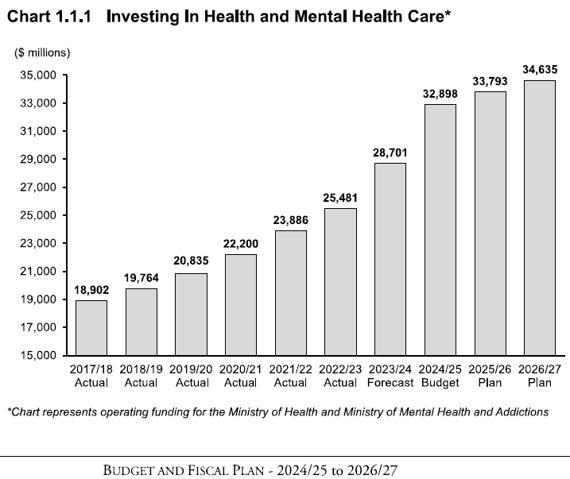
5) The table below, which was taken from the 2024-2025 provincial budget, showed then-current, historical, and projected future costs for public health care in British Columbia. Should these costs have been sufficient to provide the adequate health care spoken of by the church? Do less expensive alternatives exist, or ways of sharing the health care burden? For example, what if anything could or should be done by private, non-profit, or community organizations, including the Church and lay Catholic organizations, to ensure that efficient, quality basic health care is available to all who need it, without undue costs or delays?
The government’s 2026-27 budget provides updated numbers for last two columns, along with projections for the next two years::
2025/26: $35,017M 2026/27: $36,116M 2027/28: $37,240 2028/29: $38,404M
Care for the Elderly
- Some parties are calling for increased space in publicly-funded facilities for the elderly and long-term care patients. Should any other solutions, such as nurturing a culture of life-long intergenerational family cohesiveness and support, including home caregivers, be considered also, in addition or as alternatives to long-term residential care?
- Who should be responsible for long-term support for the elderly? Themselves? Their families? The federal or provincial governments? Charitable institutions? Some combination of these? To what extent?
- What, if anything, should be done to promote physical, spiritual, and emotional health among residents and staff in public and private homes and long-term care facilities? For example, are such facilities sometimes too large for proper inter-human connection, or sanitation? Is centralization of management of such facilities a concern? For example, can over-centralization affect the rates of infection or spread of viruses, etc.?
Education
- It has been suggested that too many Canadians fail to understand basic democratic principles, such as the responsibilities of federal, provincial, and local governments, and the proper roles of non-governmental institutions such as charities, schools, businesses, news media, and moral and religious organizations. What, if anything, can or should the provincial government do in order to promote a more comprehensive understanding of civics in British Columbia?
- Should a course of study of economics, at least one semester in length, be mandatory in high school?
- To what extent should the study of history be mandatory in high schools? Only one full credit course? Every year in high school? What aspects of history should mandatory? National? Provincial? Global? Ancient? Modern?
- Should natural family planning (NFP) techniques be taught in high school?
Culture, Arts & Tourism
Pope Francis has spoken of “ideological” or “cultural” colonization, in the process of which the popular and dominant values of the powerful are imposed on local populations. When decisions are made by governments regarding the purpose of investments injected into arts and culture, who is being consulted? Whose voices are being listened to?