
 Church Teaching
 Catholic Teaching
Catholics care about the sanctity of life because the entire purpose of each soul God endows with life is to find its way back to God by loving God and caring for all the souls God has placed around it. Voluntary termination of life any time between conception and natural death necessarily frustrates that purpose.
The source of human dignity is the likeness to God that is bestowed on each of us at the moment we are conceived. We respond appropriately to this gift by using all the time, talent, and treasure that God has entrusted to us to seek and grow closer to God, by sharing in His continuing act of creation and caring for those around us. Our first purpose is to seek God, especially in one another. If we do that, everything else will be given to us. Anything that interferes with that is contrary to the Word of God. Genesis chapter 1; Matthew chapters 6, 22 & 25
Abortion & Euthanasia
“You shall not kill.”
– the 5th Commandment
The right to life from conception to natural death is the foundation of all Catholic Social Teaching, and in particular, implies the illicitness of every form of procured abortion and of euthanasia. – 155, Compendium of the Social Doctrine of the Church
“This is not something subject to alleged reforms or ‘modernizations.’ It is not ‘progressive’ to try to resolve problems by eliminating a human life. Who can remain unmoved before such painful situations?”
– Pope Francis, Evangelii Gaudium 214
Human Engineering
Cloning and Cell Manipulation
An issue of particular social and cultural significance today, because of its many and serious moral implications, is human cloning… the simple replication of normal cells or of a portion of DNA presents no particular ethical problem. Very different, however, is cloning understood in the proper sense. Such cloning is contrary to the dignity of human procreation because it takes place in total absence of an act of personal love between spouses, being agamic and asexual reproduction. In the second place, this type of reproduction represents a form of total domination over the reproduced individual on the part of the one reproducing it…
Cloning for therapeutic use does not attenuate its moral gravity, because in order that such cells may be removed the embryo must first be created and then destroyed. 236, Compendium of the Social Doctrine of the Church
Gender Election
Everyone, man and woman, should acknowledge and accept his sexual identity. Physical, moral and spiritual difference and complementarities are oriented towards the goods of marriage and the flourishing of family life. -224 Compendium of the Social Doctrine of the Church
Men and women with homosexual tendencies must be accepted with respect, compassion, and sensitivity. Every sign of unjust discrimination in their regard should be avoided. – 358 Catechism of the Catholic Church
Population Growth; Birth Control; Family Planning
Judgment concerning the interval of time between births, and that regarding the number of children, belongs to the spouses alone. This is one of their inalienable rights, to be exercised before God… The intervention of public authorities must be made in a way that fully respects the freedom of the couple. All programmes of economic assistance aimed at financing campaigns of sterilization and contraception are to be morally condemned as affronts to the dignity of the person and the family.
The answer to questions connected with population growth must instead by sought in simultaneous respect both of sexual morals and of social ethics, promoting greater justice and authentic solidarity so that dignity is given to life in all circumstances.
All reproductive techniques — such as the donation of sperm or ova, surrogate motherhood, heterologous artificial fertilization — that make use of the uterus of another woman or of gametes of persons other than the married couple, injuring the right of the child to be born of one father and one mother who are father and mother are ethically unacceptable both from a biological and from a legal point of view. – 234-235, Compendium of the Social Doctrine of the Church
 Liberal Party of Newfoundland and Labrador
 Abortion, Euthanasia & Alternatives | Human Engineering | Population Control
The party has published no current specific statement concerning its policies relating to:
- Abortion, euthanasia, or alternatives
- Gender modification, gene manipulation, or other forms of human engineering
- Population Control
- Human Trafficking
 New Democratic Party of Newfoundland and Labrador
 Abortion, Euthanasia & Alternatives | Human Engineering | Population Control
The party has published no current specific statement concerning its policies relating to:
- The meaning or purpose of life
- Abortion, euthanasia, or alternatives
- Gender modification, gene manipulation, or other forms of human engineering
- Population Control
- Human Trafficking
 Progressive Conservative Party of Newfoundland and Labrador
 Abortion, Euthanasia & Alternatives | Human Engineering | Population Control
The party has published no current specific statement concerning its policies relating to:
- The meaning or purpose of life
- Abortion, euthanasia, or alternatives
- Gender modification, gene manipulation, or other forms of human engineering
- Population Control
- Human Trafficking
 Points to Ponder
 Points to Ponder: The Sanctity of Human Life
Points to Ponder: Life & Human Dignity
The Catholic understanding of the meaning of life is the historic foundation of all Canadian social values. Even in a secular age that in many ways has rejected the Church, it remains impossible to understand Canada, its constitution, or its Charter of Rights and Freedoms, along with documents such as the UN Declaration of Human Rights, without reference to the Catholic-Christian values from which they were woven. How does that understanding inform your thinking about the following issues?
Abortion and Euthanasia
Many of our parties, along with many of our voters, have stopped talking about or even acknowledging the evils of abortion, Socially-Assisted Death (SAD), and other sins against the sanctity of the body and the dignity of life. How can this be? Is it because we as a society have been distracted by the comforts and worries of modern life, and lost touch with the purpose of life? Or are we simply hiding, like the timid steward of Matthew 25:18? Abortion, SAD and other sins are a significant issue in Canada: medical homicide (abortion and SAD) is the leading cause of death in Canada. (https://ccpodcast.ca/@CatholicConscience/episodes/election-2025-the-sanctity-of-life)
- Aside from looking to our Catholic values (https://catholicconscience.org/catholiccivics/) in discerning our votes, what can we, as individuals, families, groups, and parishes do to keep this issue alive in the hearts and minds of Canadians?
- Is it possible for us to keep this issue alive in ways that will serve to gather society, rather than to promote scattering and division?
- Aside from appropriate legislation, what forms of response can or should we promote? How can we help all of those affected by the social sins (https://catholicconscience.org/social-sin/) of euthanasia and abortion, or tempted by them?
Government Policy Values
For years many of our political parties have been fond of asserting, in dozens of ways, that various groups of Canadians “deserve” or are “entitled to” a very wide variety of benefits in order to enable them (us) to live lives of dignity. They are much more reluctant to offer any indication of what they mean by a “dignified” life, or any way of measuring the effect of the benefits they propose on improving it. Indeed, the only indexes used by most governments to gauge wellness of any kind are gross domestic production levels (GDP) – the aggregate worth of the material objects our society produces. This is believed by many observers to have contributed to what they view a loss of the common conception of the proper meaning of the dignity or purpose of life, replacing that common conception and its accompanying sense of community, shared culture, and a sense of the common good with an obsessive consumerism and pursuit of comfort and material wealth. The result has been a postmodern individualism that leaves human beings feeling isolated and on their own.
In his encyclical Fratelli tutti, Pope Francis observed that:
Today, in many countries, hyperbole, extremism and polarization have become political tools. Employing a strategy of ridicule, suspicion and relentless criticism, in a variety of ways one denies the right of others to exist or to have an opinion. Their share of the truth and their values are rejected and, as a result, the life of society is impoverished and subjected to the hubris of the powerful. Political life no longer has to do with healthy debates about long-term plans to improve people’s lives and to advance the common good, but only with slick marketing techniques primarily aimed at discrediting others. In this craven exchange of charges and counter-charges, debate degenerates into a permanent state of disagreement and confrontation.
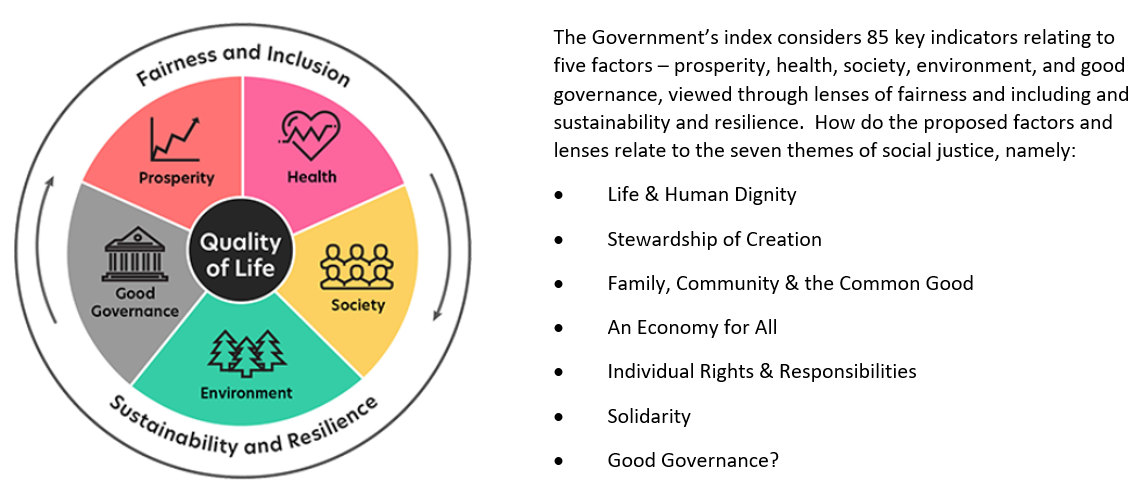
Recently some parties have begun to propose various “wellness” indicators as an alternative to reliance on GDP in gauging social wellbeing. Such indicators are based on factors said to represent the health, happiness, and well-being of society and its individual members. And in 2019 the current Canadian Federal government quietly introduced a new “Quality of Life” measure in its instructions to new cabinet ministers, and caused the creation of a “Quality of Life Hub”. The Hub introduces the index, a draft method for measuring it, and solicits public feedback. (See https://www160.statcan.gc.ca/index-eng.htm)
1) Bearing in mind that it is citizen voters who are ultimately responsible for the behaviour of democratic governments, how should Catholics respond to the government’s call for comment, with properly and prayerfully-formed consciences? Should they involve their provincial and municipal governments in the discussion? If so, how?
How do the following questions, and their answers, factor into the government’s proposed framework? How do they relate to life and politics in the Province of Newfoundland and Labrador?
2) What limits should be placed on voluntary termination of human life, either prior to birth or at any time before death? What can or should be done at the federal level, and what should be left to the provinces, or to private, religious, or other non-profit organizations?
3) What options is our society able to offer to fearful, reluctant or unwilling mothers, as alternatives to abortion and to support unwanted children?
4) Is it appropriate to allow minors, or those suffering mental or emotional illness, to consider suicide as a health care option without consulting their parents or families? What options can be offered by provincial or federal governments to families of persons who are being encouraged to consider medically-assisted suicide?
6) Is it appropriate to require unwilling healthcare personnel to participate in SAD, abortion, or other actions that are contrary to Catholic belief, or to their individual well-formed consciences? Should such persons be legally protected from performing tasks that go against their conscience? If so, how and to what extent?
7) To what extent should voluntary, elective services that are morally questionable to large numbers of individuals, such as the voluntary termination of life or the voluntary “modification” of gender, be financed publicly through mandatory taxation? If such services are to be offered, should they be financed by the individuals who elect to access them, or by sympathetic charities, or by dissenting taxpayers?
8) All national political parties have called for continued commitment to the fight against the evil of human trafficking. What more, if anything, could be done to fight this evil, at the personal, local, civic, municipal, and provincial levels to protect vulnerable people? Are you able to recognize the signs of trafficking? If activity that you felt included human trafficking came to your attention, what could or should you do about it?
9) Are federal restrictions and controls on cloning and the use of human cells, fetuses, and body parts properly crafted? What, if anything, should be done differently? Should there be more discussion of this serious moral issue in our society?
 Listen: Sanctity of Life Audio Files